Mobility and rehabilitation equipment ranges from a simple wrist support to a wheelchair someone will use every day. Getting it right depends less on the product itself than on matching it to the person, the setting and the care plan. This guide explains what to decide before ordering for a physiotherapy practice, hospital ward, frail care facility, sports team or a family member at home.
1. Start with the user and the clinical plan
Most mobility products work well only when they fit the person using them. Before ordering, establish:
- The user’s height, weight and, where relevant, limb or joint measurements.
- Where the equipment will be used: indoors, outdoors, on uneven ground, in a bathroom or in a vehicle.
- Whether the need is short term, such as recovery after an injury, or long term.
- Any recommendation from the treating physiotherapist, occupational therapist or doctor.
Where a clinician is involved, follow their assessment for the type, size and setting of the equipment, and use it according to the manufacturer’s instructions.
2. Walking aids, wheelchairs and scooters
Walking Aids include crutches, walking sticks and frames. Check the maximum user weight, the height adjustment range, the type of handgrip and the condition of rubber tips or ferrules, which wear and should be replaceable.
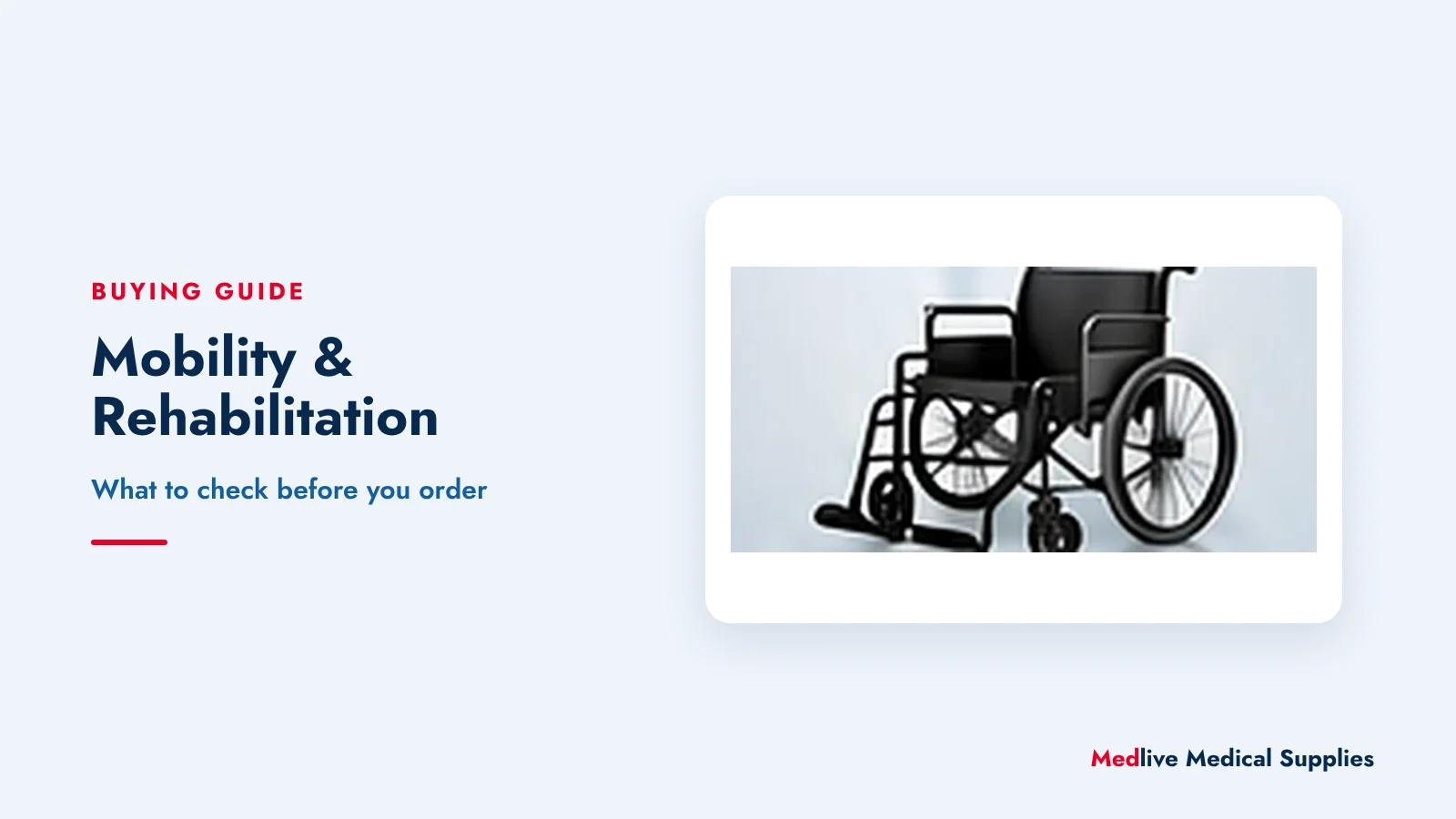
For Wheelchairs & Scooters, compare:
- Seat width and depth: a poor fit affects comfort, posture and skin.
- Self-propelled or attendant-propelled: larger rear wheels allow the user to push themselves; smaller wheels suit transport by a carer.
- Weight and folding: important if the chair will be lifted into a car or stored in a small space.
- Safe working load and brakes: confirm these on the product page or with us before ordering.
- Batteries and charging: for powered scooters, ask about range, charging and replacement parts.
3. Bathroom safety and daily living
Many falls happen in the bathroom. The Bathroom & Daily Living category covers aids that make washing, toileting and everyday tasks safer. Measure the space first: the height of the toilet, the width of the shower and the depth of the bath. Check maximum user weight, adjustable legs and non-slip feet, and whether the item can be cleaned with the products your facility uses.
4. Supports, braces and orthotics
The Supports, Braces & Orthotics category includes items such as the Mueller Neoprene Ankle Support with Straps and the Actimove Wrist Stabilizer. Points to consider:
- Sizing: use the manufacturer’s size chart and measure at the point it specifies. Sizes differ between brands.
- Left, right or universal: some supports are side-specific.
- Level of support: soft elastic supports give compression and comfort; braces with straps or stays restrict movement more. The right choice depends on the injury and the clinician’s advice.
- Material: neoprene retains warmth; breathable fabrics may suit longer wear. Ask about latex if allergies are a concern.
Practices that fit supports regularly often keep a range of sizes on hand rather than ordering for each patient.
5. Exercise, therapy and recovery equipment
Exercise & Rehab Equipment includes products such as Theraputty Blue (Firm) for hand strengthening and the AIREX TrExercise 180 Exercise Mat. Graded products such as putty and resistance bands are usually colour-coded by resistance, but colour scales vary between brands, so check the stated resistance level and stock a range so patients can progress.
For clinics, Electrotherapy & Physiotherapy equipment needs careful comparison: the treatment modes offered, the number of channels, power supply, the cost of electrodes and other consumables, and who will service the unit. Practitioners should use these devices within their scope of practice and according to the manufacturer’s instructions.
Supporting categories include Hot & Cold Therapy packs, Massage & Recovery tools, and Acupuncture & Dry Needling supplies for qualified practitioners. For needles, confirm gauge, length, pack quantity and sterile single-use packaging, and plan for safe sharps disposal.
6. Common mistakes to avoid
- Ordering a wheelchair or walking aid without measuring the user or checking the weight limit.
- Choosing a brace by price alone when the clinician has asked for a specific level of support.
- Forgetting doorway widths, steps and vehicle space when ordering larger equipment.
- Overlooking consumables such as electrodes, ferrules and replacement straps.
- Sharing personal items such as supports between patients without a cleaning process that suits the material.
To compare similar items side by side, use the product comparison tool.
How to order from Medlive
Browse the full Mobility & Rehabilitation department. Customers in South Africa see verified ZAR prices including VAT where available and can add items to the cart; customers in other countries see price on request (USD) and can request a quotation. Freight is confirmed for each order, which matters for bulky items such as wheelchairs, and payment is by EFT once the final total has been confirmed in writing. Practices, care homes and hospitals buying in volume can use bulk orders, and institutional buyers can submit a tender enquiry.