Personal protective equipment and infection control products are bought in larger volumes and more often than almost anything else a clinic or hospital orders. Small differences in glove material, mask type or disinfectant pack size add up quickly across a year. This guide explains what to decide before you order, what the common specifications mean and how to order from Medlive.
1. Start with the task, not the product
Group your needs by activity before comparing products. Routine examinations, wound dressing, surgical procedures, cleaning, laboratory work and waste handling each call for different protection. Your facility’s infection prevention and control policy should set the minimum level of protection for each task; buy to match that policy rather than to a single “one size fits all” item.
- Who will use it: clinical staff, cleaners, laboratory staff, carers or patients.
- How often: estimate monthly use per ward or room so you can order in sensible pack quantities.
- Where it is stored: most PPE should be kept dry, out of direct sunlight and used within its expiry date.
2. Gloves: material, size and standard
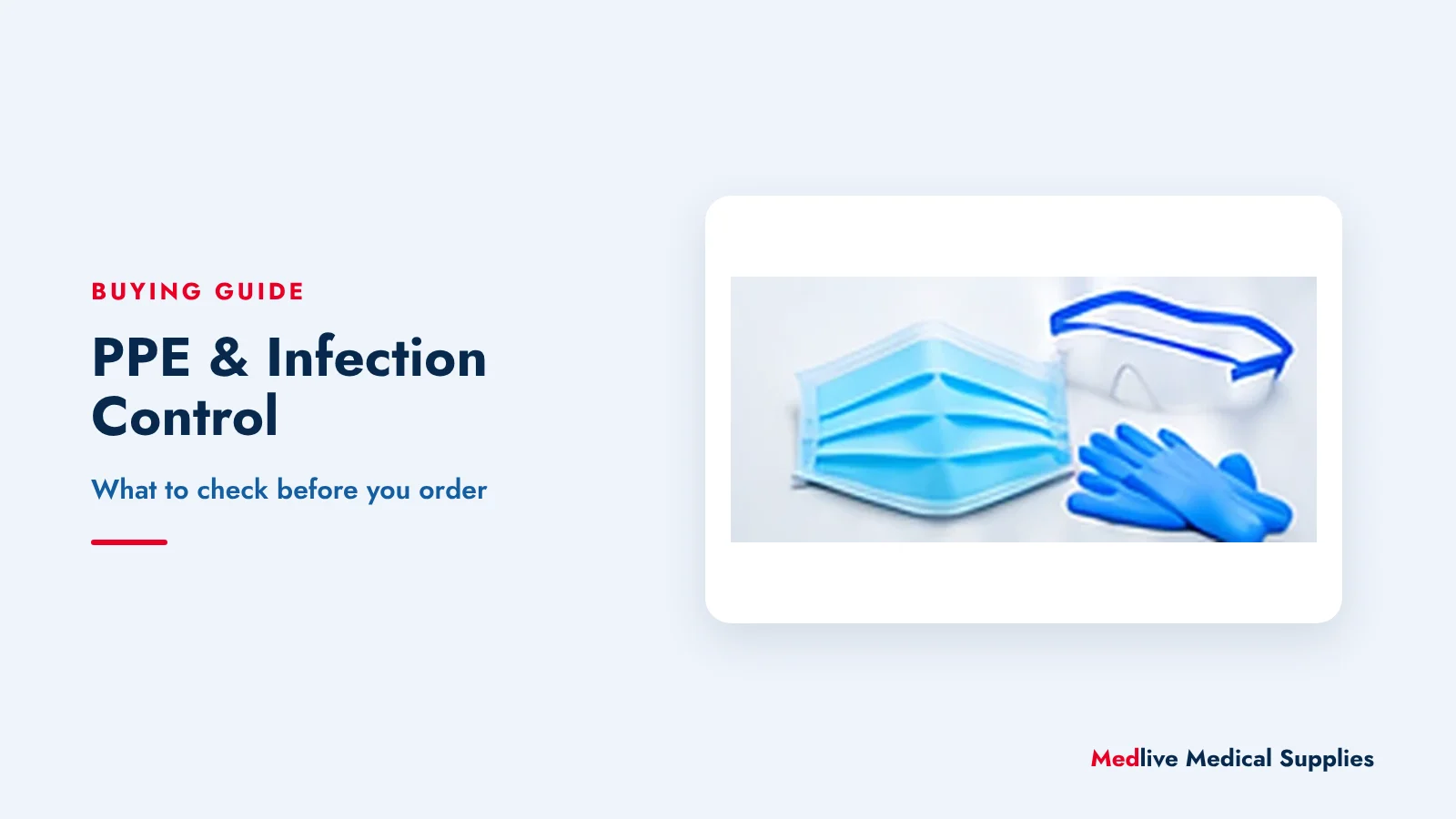
Our gloves range covers examination and procedure gloves. Points to check:
- Material: nitrile is widely used where latex sensitivity is a concern and offers good puncture resistance; latex offers fit and dexterity but should be avoided for staff or patients with latex allergy; vinyl is generally suited to short, low-risk tasks.
- Powder-free: powder-free gloves are now the usual choice in clinical settings. For example, the range includes nitrile examination gloves, powder free, in boxes of 100.
- Sterile or non-sterile: examination gloves are usually non-sterile; sterile gloves are used where the procedure requires them. Follow your facility’s protocol.
- Size mix: order a realistic spread of sizes. Poorly fitting gloves tear more easily and are often double-used.
- Standards: medical gloves are commonly tested to EN 455, a European standard in four parts covering freedom from holes, physical properties such as strength, biological evaluation, and shelf life. Ask for the manufacturer’s documentation if your tender or policy requires it.
3. Masks and respirators are not the same thing
The masks and respirators category contains two different types of product, and they should not be substituted for each other.
- Surgical (medical) face masks, such as a 3-ply surgical face mask in a box of 50, mainly protect the patient and the environment from the wearer. Under EN 14683 they are classed as Type I, Type II or Type IIR. Type II has higher bacterial filtration efficiency than Type I, and Type IIR adds splash resistance.
- Respirators are designed to protect the wearer and are certified to respirator standards, for example FFP2 and FFP3 under the European standard EN 149, or N95 under United States NIOSH approval. A respirator only performs as intended when it fits the wearer’s face, so many facilities run fit-testing programmes.
Your infection control lead or occupational health policy should decide which type is required for each area.
4. Gowns, drapes, coveralls and shoe covers
In gowns, drapes and coveralls, compare fluid resistance, whether the item is sterile or non-sterile, sizing, closure type (ties or Velcro) and whether it is single-use or reusable. Disposable shoe covers, for example polypropylene non-slip shoe covers supplied as a box of 100 pairs, are useful for theatres, isolation areas and clean zones. Check the slip resistance on your own floors before committing to a large order.
5. Disinfectants, hand hygiene and waste
The disinfectants and waste category covers hand rubs, surface cleaners and containers for clinical waste. Examples include B Braun alcohol hand gel disinfectant (500ml), Surfasbac surface disinfectant and cleaner (5L) and a 20L medical sharps waste bin.
- Use the right product for the surface: read the label for the surfaces and equipment it is suitable for, the dilution (if any) and the required contact time.
- Pack size: small bottles suit point-of-care use; larger containers suit refilling and cleaning teams. Check that your dispensers accept the bottle size.
- Safety data sheets: request the safety data sheet for chemical products so staff know how to store and handle them.
- Sharps and waste: choose container sizes to match how quickly each area fills them, and follow your facility’s healthcare waste procedures and local regulations for collection and disposal.
6. Common mistakes to avoid
- Buying on unit price alone without comparing pack quantity. Always compare the price per glove, per mask or per litre.
- Treating a surgical mask as a respirator, or the reverse.
- Ordering a single glove size for a whole team.
- Over-ordering items with short shelf lives and then using them past expiry.
- Not checking the supplier. Our guide on how to check a medical device supplier with SAHPRA explains what to look for in South Africa.
For broader clinic purchasing, see our checklist for buying medical supplies for a clinic.
7. How to order from Medlive
Browse the full PPE & Infection Control department. Customers in South Africa see verified ZAR prices including VAT on eligible products and can add them to the cart. Customers in our other markets see “Price on request (USD)” and can use Request a Quotation.
For regular or high-volume PPE orders, use Bulk Orders so volume pricing can be quoted, or Quick Order if you already know your SKUs. Hospitals, NGOs and government buyers can submit requirements through Tender Enquiry. Freight is confirmed for each order, and payment is by EFT once the final total has been confirmed in writing. Buyers outside South Africa can read ordering medical supplies outside South Africa.