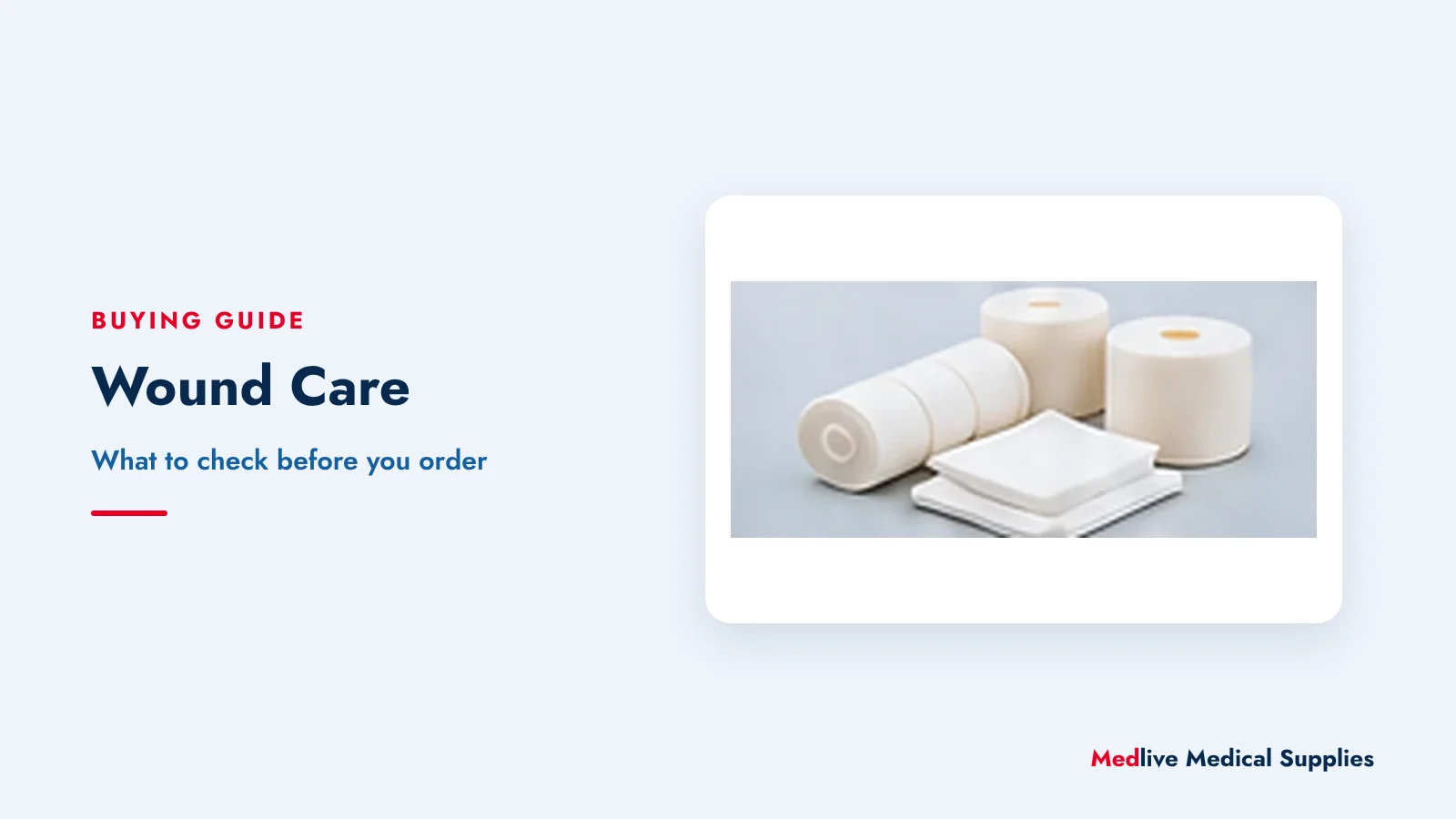
Wound care products are used every day in clinics, wards, sports settings and homes. Because they are consumed in volume, small differences in size, adhesion or pack quantity add up quickly. This guide explains how to plan a wound care order, what common product descriptions mean and how to order from Medlive. It is general purchasing guidance only: the choice of dressing or bandage for a particular wound should follow the clinician’s assessment, your facility’s wound care protocols and the manufacturer’s instructions for use.
1. Plan by setting and volume
Start by listing who uses the products and how often.
- Clinics and wards need a reliable range covering everyday dressings, bandages and tapes, ordered against a formulary agreed with nursing staff.
- Sports and physiotherapy settings use larger quantities of rigid strapping, cohesive bandages and kinesiology tape.
- Home care and workplaces need a smaller, simpler selection that people can use without training.
Keeping a short standard list also helps staff find items quickly and makes it easier to compare prices between orders. Review usage records before ordering so that you buy realistic quantities and avoid items expiring or deteriorating on the shelf.
2. Dressings
The Dressings category covers primary and secondary dressings in a range of materials and sizes. When comparing products, check:
- Size and shape: dimensions are usually given in centimetres. Stock the sizes your staff actually use.
- Sterile or non-sterile: confirm what the packaging states and whether items are individually wrapped.
- Adhesive or non-adhesive: some dressings need a separate tape or bandage to hold them in place.
- Pack quantity: compare the cost per dressing, not the cost per box.
Which dressing type suits a particular wound is a clinical decision, so involve the nursing or medical team in setting your list.
3. Bandages
Bandages include conforming, crepe, cohesive and support bandages, for example the Athletic Cohesive Self-Adherent Bandage 150mm. Width is the main size measure, often given in millimetres or centimetres, along with stretched or unstretched length. Cohesive bandages stick to themselves rather than to skin, which makes them quick to apply. Check whether the product is intended for retention, support or compression; compression should only be applied as directed by a clinician.
4. Tapes and plasters
Tapes & Plasters covers fixation tapes, strapping tapes and kinesiology tapes, for example Zinc Oxide Plaster Tape 100mm x 5m, Leukotape K Beige 5cm x 5m and HT Kinesiology Tape 5cm x 5m. Product names usually give width and roll length, so compare these directly.
- Rigid strapping tapes, such as zinc oxide tape, are generally used where firm support is wanted.
- Kinesiology tapes are elastic and are applied using the techniques taught to physiotherapists and other trained practitioners.
- Fixation tapes hold dressings and devices in place. Consider skin sensitivity and how easily the tape tears and removes.
5. Casting and splints
Casting & Splints covers casting tape, padding and splints. Compare the material, width, setting time stated by the manufacturer, and whether splints are pre-formed or mouldable. Stock padding and stockinette in widths that match your casting tape, and keep a range of splint sizes for adults and children. Casting materials should be stored as the manufacturer directs and applied by trained staff.
6. Mistakes to avoid
- Ordering by product name alone without checking width, length and pack quantity.
- Comparing prices per box rather than per unit.
- Buying non-sterile items where your protocols require sterile ones.
- Substituting dressing types without the agreement of clinical staff.
- Over-ordering items with a limited shelf life or specific storage needs.
For a broader view of what a clinic should keep in stock, see the clinic supplies checklist.
7. How to order from Medlive
Browse the full Wound Care department. Customers in South Africa see verified ZAR prices including VAT on eligible products and can add them to the cart. Customers in other African countries see “Price on request (USD)” and can request a quotation; see ordering medical supplies outside South Africa for how that works. Freight is confirmed for each order, and payment is by EFT once the final total has been confirmed in writing.
Clinics, sports organisations, NGOs and hospitals buying regularly can use bulk orders for volume pricing on quotation, and institutional buyers responding to a formal requirement can submit a tender enquiry. If you need help matching a product list, contact us.