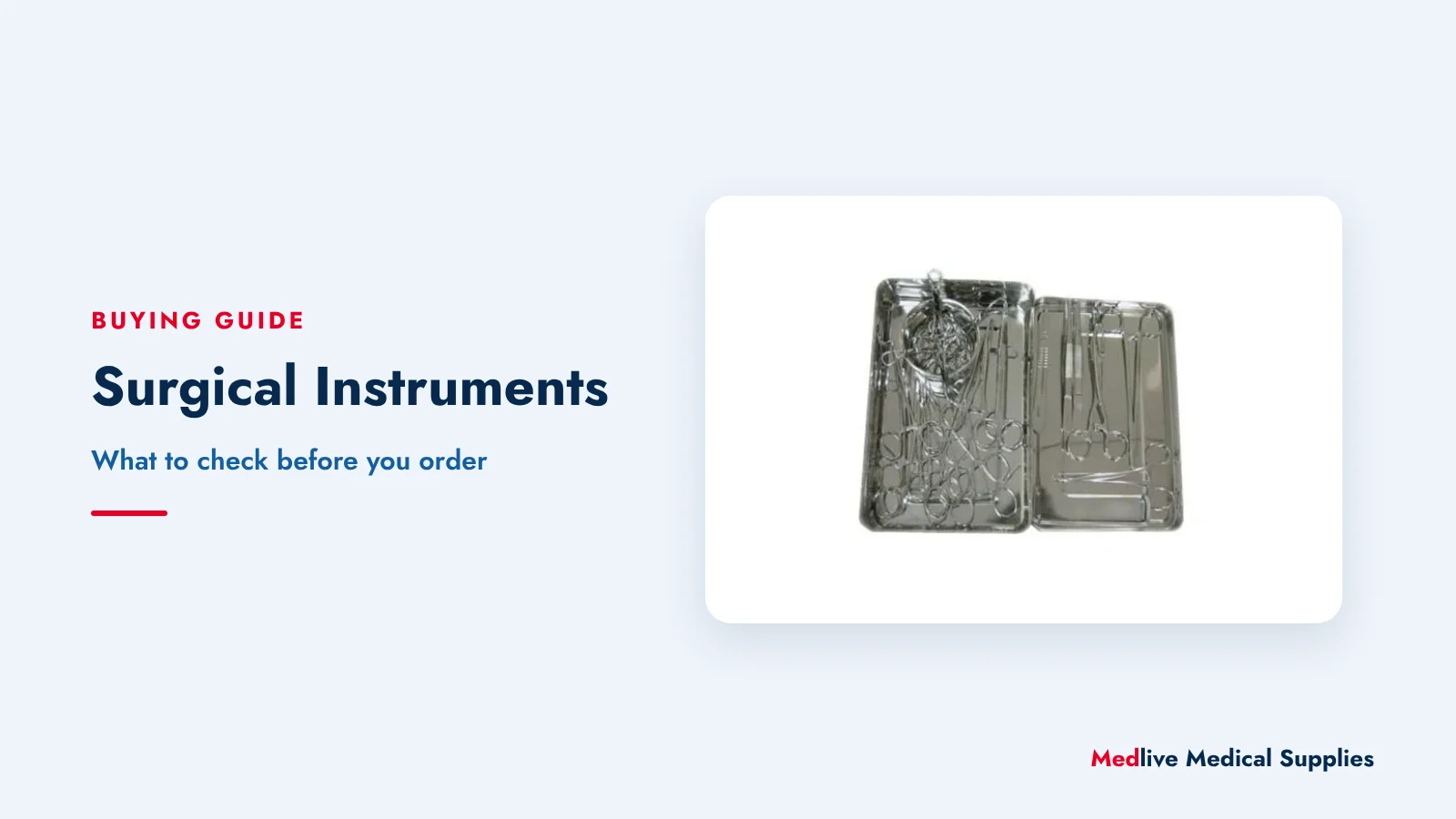
Surgical instruments are bought for years of use, not for a single procedure. A well-chosen pair of artery forceps can serve a clinic for a long time if it is cleaned, inspected and sterilised correctly, while a poorly made one can fail at the joint within months. This guide explains how instruments are named, when to choose reusable or single-use items, how to build sets and procedure packs, and what to check when a delivery arrives. It covers purchasing only; technique and instrument selection for a procedure remain decisions for the surgeon, clinician or facility protocol.
1. How surgical instruments are named
Most instrument names follow the same pattern: the pattern or eponym (for example Spencer Wells, Mayo-Hegar or Iris), the type (artery forceps, needle holder, scissors), the length in centimetres and the tip shape (straight or curved). In our surgical instruments range you will see names such as Spencer Wells Artery Forceps Straight 18cm, Mosquito Artery Forceps Curved 12.5cm, Needle Holder – Mayo-Hegar, 14cm, Iris Scissors – 11.5cm and Bull-Nosed Scissors 11cm.
- Length matters for reach and handling. Ask the clinicians who will use the instrument which lengths they prefer, and keep to them when you reorder.
- Straight versus curved is a user preference set by the procedure. Do not substitute one for the other without checking.
- Same name, different maker: two instruments with the same pattern name can differ in finish, steel grade and weight. When comparing quotations, compare like with like.
2. Reusable stainless steel or single-use
Reusable stainless steel instruments cost more per item but can be reprocessed many times. Single-use instruments remove the reprocessing step but are discarded after each patient. The right choice depends on your facility rather than on the instrument.
| Consider | Reusable stainless steel | Single-use |
|---|---|---|
| Upfront cost per item | Higher | Lower |
| Reprocessing | Cleaning, inspection, packing and sterilisation after every use | None; discard after use |
| Ongoing cost | Staff time, pouches, indicators, autoclave cycles, repairs | Repeat purchases and waste disposal |
| Suits | Facilities with reliable sterilisation capacity | Outreach, low-volume sites or where reprocessing is not available |
Before buying more reusable instruments, check that your sterilisation capacity can keep up: how many cycles your autoclave runs per day, how many trays fit per load, and whether staff have time to clean and pack. Our autoclave buying guide explains capacity, and the sterilisation and hygiene department carries pouches, indicators and related supplies. Single-use items must never be reprocessed.
3. Sets, packs or individual instruments
Ready-made sets are convenient for equipping a new room, a training programme or a mobile clinic. Individual instruments are better for replacing worn or lost items and for building sets that match your own protocols.
- Minor surgery: a general set such as the Basic Surgery Set gives a starting point. Compare the contents list with what your clinicians actually use before ordering in quantity.
- Gynaecology: packs such as the Dilation & Curettage Pack – 25 Piece and Cervical Pack – 24 Piece bring commonly grouped instruments together. Ask for the full contents list with your quotation so the theatre or procedure room team can confirm it matches their tray list.
- Training: dissecting kits, for example the Dissecting Kit – 6 Piece, are suited to student and laboratory use. Universities and colleges often buy these by class size each year.
- Organisation on the tray: items such as the Magnetic Instrument Mat Reusable – Autoclavable help keep instruments in place during use. Check the manufacturer’s reprocessing instructions before including any accessory in a sterilisation load.
4. Disposable specula
Disposable vaginal specula, such as the Vaginal Speculum Disposable – Box of 100, are widely used in clinics and screening programmes because they remove reprocessing entirely. They are made in different sizes, so confirm which sizes your clinicians use and in what proportion before ordering by the box. Store boxes in a clean, dry place and use older stock first.
5. Quality checks when instruments arrive
Inspect every reusable instrument before it enters circulation. A short receiving check catches defects while they can still be raised with the supplier.
- Box joints should move smoothly without grinding or excessive play.
- Ratchets on forceps and needle holders should engage and hold at each step and release cleanly.
- Tips and jaws should meet evenly when closed, with no gaps, overlap or misalignment.
- Scissors should cut cleanly along the full length of the blade.
- Surface and markings: no pitting, rough edges or flaking finish, and legible identification markings where the manufacturer applies them.
Record any issue with photographs and the delivery reference, and report it promptly.
6. Care, inspection and replacement planning
Instrument life depends heavily on reprocessing. Follow the manufacturer’s instructions and your facility’s sterilisation procedures for cleaning, drying, lubrication of hinged instruments and inspection before packing. Remove damaged instruments from use rather than returning them to the tray.
Plan replacements rather than waiting for failures. Keep a simple register of instruments per set, note items withdrawn for damage, and budget for a proportion of each set to be replaced each year. Institutions buying through annual contracts can group these replacements into one order. For gloves, drapes, sutures and other theatre consumables, see our surgical supplies buying guide.
7. How to order from Medlive
Browse the surgical instruments sub-category or the wider surgical supplies and consumables department. South African customers see verified prices in ZAR including VAT where available and can add items to the cart. Customers in other African countries see Price on request (USD); freight and import paperwork are confirmed on the quotation.
- For mixed instrument lists or full sets, use Request a Quotation and include pattern names, lengths, tip shapes and quantities.
- For volume requirements, such as equipping several procedure rooms or a training cohort, use Bulk Orders.
- Hospitals, government departments and NGOs responding to a formal procurement process can submit requirements through Tender Enquiry.
Freight is confirmed per order, and payment is made by EFT once the final total has been confirmed in writing.