Neonatal equipment is bought less often than most ward stock, but each item tends to stay in service for years and is used for the most vulnerable patients in a facility. This guide covers the purchasing side of radiant warmers, incubators, phototherapy units, bassinets and transcutaneous jaundice meters in our infant care and incubators range. How any of this equipment is used on a baby is a matter for your neonatal team, your facility’s protocols and the manufacturer’s instructions for use.
1. Radiant warmers, incubators and transport incubators
The first decision is the type of care environment the unit must provide.
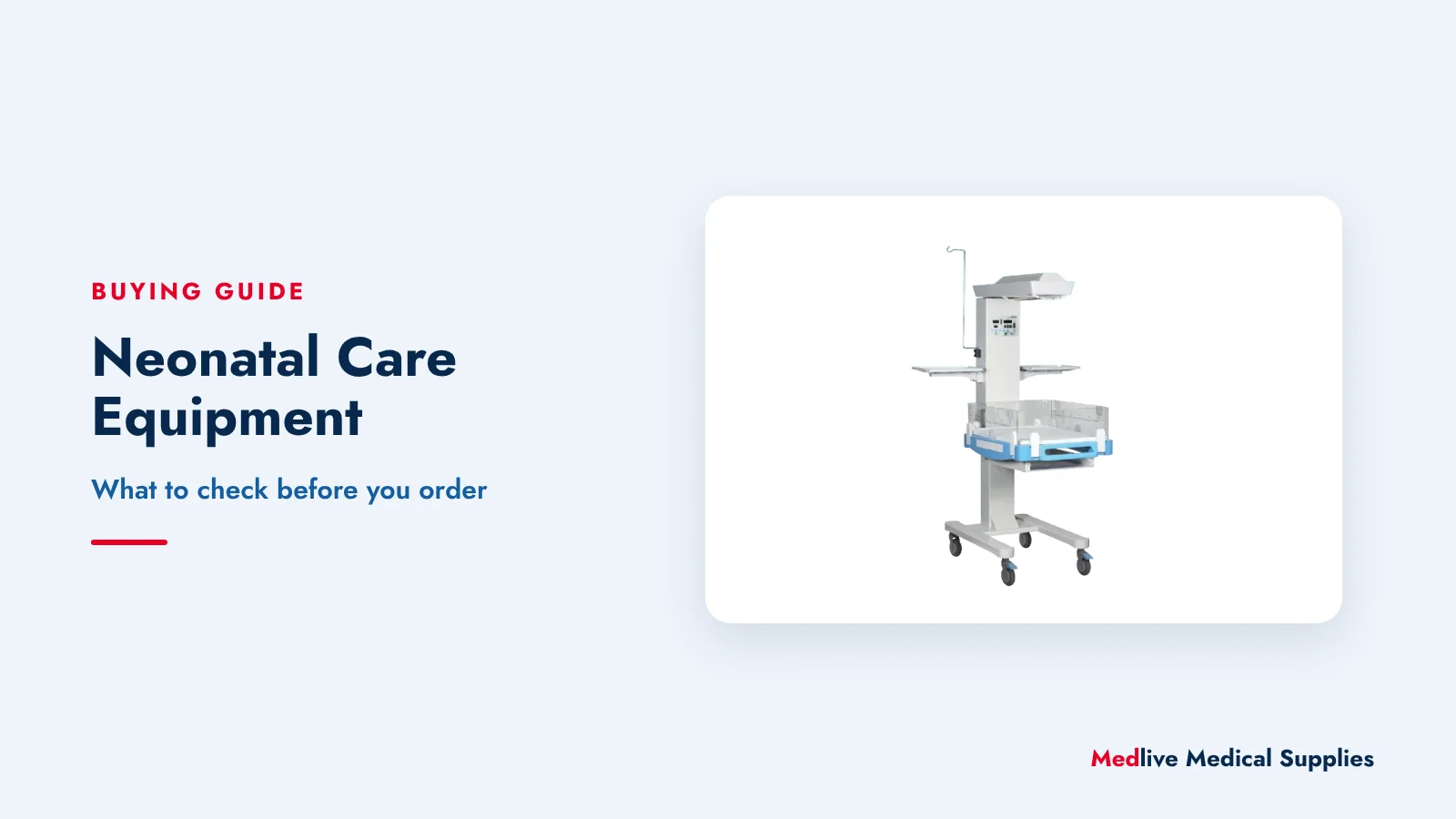
- Radiant warmers heat the baby from an overhead source on an open bed. Open access makes them common in delivery rooms and resuscitation areas, where staff need to reach the baby quickly. The range includes, for example, the Infant Warmer – Radiant Heat.
- Incubators provide closed care: the baby lies inside an enclosed hood with controlled warmth, and staff work through access ports. They are typically used in neonatal units and special care nurseries.
- Transport incubators are built to move a baby between areas or facilities, for example the Neonatal Incubator – Transport. Power is the key question here: ask whether the unit runs on mains, an internal battery, a vehicle supply or a combination, and how the battery is charged and replaced. Confirm this against the ambulances or vehicles you actually use.
Many facilities need more than one type. Map where babies are born, stabilised, nursed and moved before deciding quantities.
2. Temperature control, alarms and what to ask for
Warmers and incubators differ in how they control heat. Many offer a manual mode and a servo mode, in which output is adjusted using a skin temperature probe. Which mode is used, and the settings, are clinical decisions. For purchasing, ask the supplier for the manufacturer’s specification sheet and check:
- The control modes available and the temperature range stated by the manufacturer.
- The alarms listed in the specification, such as temperature, probe and power alarms, and whether they are audible and visible from where staff work.
- Display readability, mattress tilt, access ports and whether a scale or other options are built in or optional.
- Electrical requirements and how the unit behaves after a power interruption.
Do not rely on a product name for any of these points. If the specification sheet does not state a feature, assume it is not included until the supplier confirms it in writing.
3. Phototherapy units
Phototherapy units, for example the Phototherapy Unit XHZ-90L and Phototherapy Unit XHZ-200, are used to treat neonatal jaundice under clinical direction. When comparing units, take the light source, irradiance and treatment area only from the manufacturer’s documentation, not from a catalogue summary. Practical questions to ask include:
- Whether the light source is LED or lamp-based, and the expected lamp or LED life stated by the manufacturer.
- Whether the unit is free-standing, mounts over a cot or works with an incubator or warmer you already own.
- How irradiance is checked during the life of the unit, and whether a meter is needed.
- The cost and availability of replacement lamps or light panels.
Eye protection for babies and other precautions during phototherapy form part of the clinical protocol. Make sure the consumables your protocol calls for are on the same order.
4. Transcutaneous jaundice meters and bassinets
A transcutaneous jaundice meter, such as the Jaundice Detector Transcutaneous – Neonatal, gives a non-invasive reading through the skin and is generally used as a screening tool. Whether and when a result needs confirming by a blood test is set by your clinical protocol. Ask about calibration or checking, the power source, any single-use tips and how readings are recorded.
Bassinets are simpler purchases but are used in large numbers on postnatal wards. The range includes, for example, the Bassinet Mobile Frame with Blanket Tray. Check that the frame moves easily in your corridors and lifts, that the castors lock, that the basket or cot is easy to remove for cleaning, and that storage space suits your ward routine. Weighing equipment is covered separately in our medical scales and height measures buying guide.
5. Cleaning, spare parts and service
Neonatal equipment is cleaned and disinfected frequently, so ask for the manufacturer’s cleaning instructions before you buy and confirm the products your infection control team uses are compatible with the hood, mattress and plastics.
Plan for parts that wear out or go missing: hoods and access port seals, mattresses, skin temperature probes, lamps, filters and batteries. Ask which parts are available, whether probes are single-use or reusable, and what servicing or calibration the manufacturer recommends. Staff training at handover is worth requesting for any unit with alarms or servo control.
In areas with unstable mains power, consider voltage protection and the unit’s battery or backup arrangements. Raise this with us when you request a quotation so the right accessories can be priced.
6. Planning a neonatal equipment purchase or tender
Neonatal equipment is often bought as part of a wider maternity project. Our labour and delivery equipment buying guide covers the delivery room, and for the wider range see our maternal and infant care buying guide. A clear specification listing the type of unit, power requirements, alarms, accessories, spares and training allows like-for-like comparison of quotations.
How to order from Medlive
Browse the infant care and incubators range or the full maternal and infant care department. Customers in South Africa see verified ZAR prices including VAT where available; other items and all other countries are priced through a quotation request, with freight and import paperwork confirmed on the quotation. For several units or ward fit-outs, use bulk orders, and hospitals, health departments and NGOs can send specifications through a tender enquiry. Payment is by EFT once the final total is confirmed in writing.