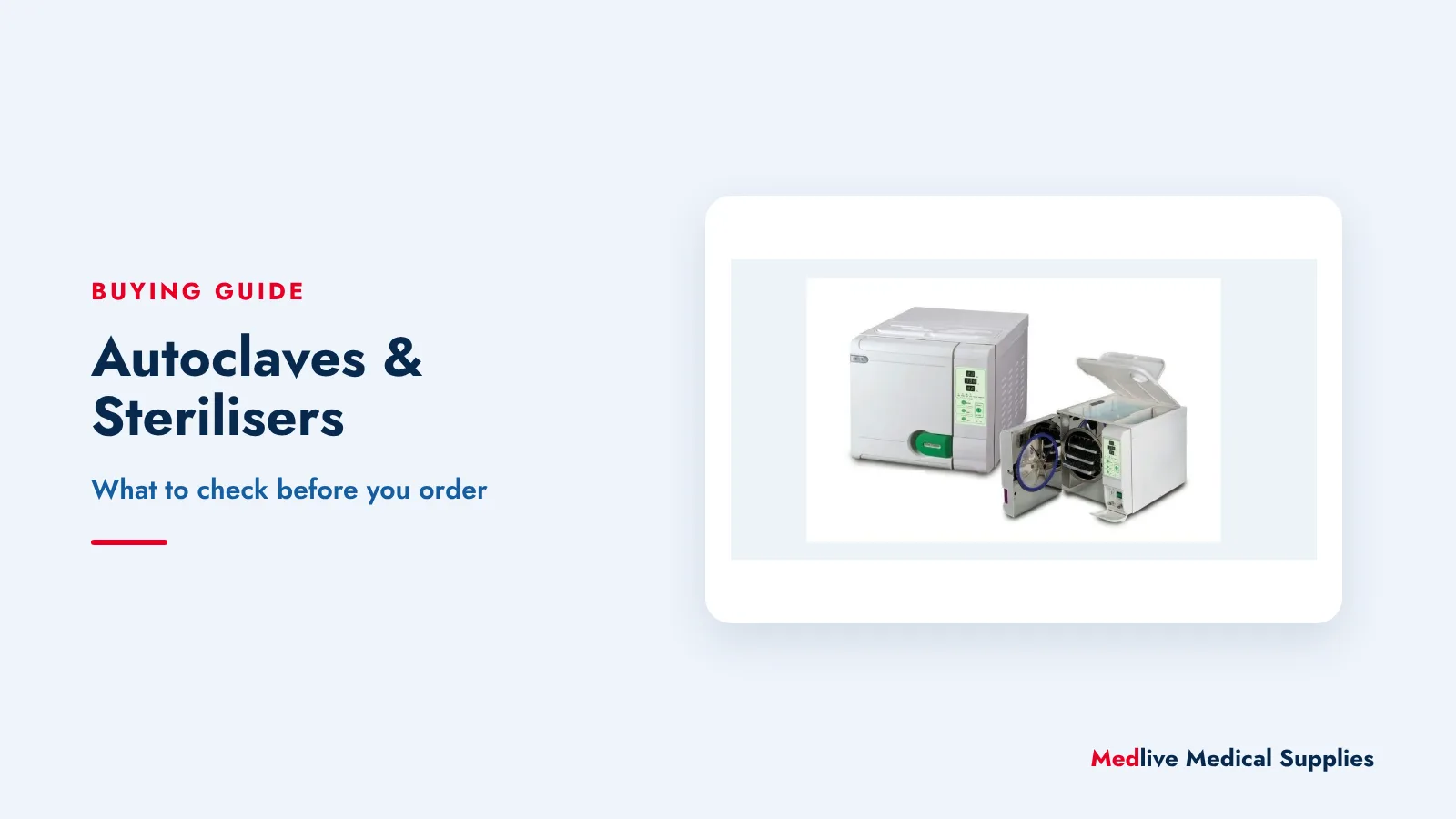
An autoclave is one of the most important purchases a practice or clinic makes, because every reusable instrument that goes back into use depends on it. The wrong type or size causes problems that are hard to fix later. This guide explains the main types of benchtop and vertical steam steriliser, what to check in the specifications and how to order from Medlive.
1. Start with what you need to sterilise
Before comparing models, list the items your facility reprocesses on a typical day:
- Solid, unwrapped instruments such as forceps, scissors and dressing instruments.
- Wrapped or pouched instruments that must stay sterile in storage until use.
- Hollow items with narrow channels, such as dental handpieces, cannulae and some tubing.
- Porous loads such as textiles, gauze and drapes.
The load types decide which autoclave is suitable, so agree this list with clinical and infection control staff first.
2. Class B, N and S: what the letters mean
Small steam sterilisers are commonly described using the cycle types in the European standard EN 13060. In general terms:
- Type B (often called Class B) cycles use a vacuum pump to remove air from the chamber, usually in several pulses, before steam enters. This helps steam reach inside wrapped, porous and hollow loads. Most practices that sterilise wrapped instruments or handpieces look at Class B units, for example the Autoclave Steriliser – Tabletop 23L (Class B) or the larger Autoclave Class B Vertical 75L BKQ-B75.
- Type N cycles rely on steam displacing air by gravity. They are intended for unwrapped solid instruments and are not suitable for wrapped, porous or hollow items.
- Type S cycles are specified by the manufacturer, who states which loads the cycle has been tested for. Use an S-type unit only for the loads listed in its instructions.
If a listing does not state a class, ask for the manufacturer’s specification and confirm in writing which load types the model is designed to process.
3. Chamber size, cycle time and drying
- Chamber volume: benchtop units range from small chambers, such as the 8L Electric Heated Steam Autoclave Steriliser, to around 23 litres; vertical units like the 75L model above suit higher volumes. Estimate your daily trays or pouches and the cycles needed.
- Cycle time: ask for the full cycle time, including heating, sterilising and drying, not only the holding time.
- Drying: wrapped loads must come out dry before storage. Vacuum drying generally gives better results with pouched instruments.
- Automation and records: fully automatic units, for example the Autoclave SA230FA Fully Automatic Table Top, run cycles from a programme. Check whether the unit prints or stores cycle records, as many facilities need a log for every load.
- Footprint: measure the bench or floor space, allowing room for ventilation and safe unloading.
4. Water and power requirements
Most benchtop autoclaves need distilled or deionised water rather than tap water, because minerals in tap water can build up in the chamber and pipework. Check the manufacturer’s water specification, and include the cost and supply of suitable water in your running costs.
For power, confirm the voltage, the rated power and the type of socket or connection required. Larger units may need a dedicated circuit installed by an electrician. Where the power supply is unreliable, discuss with your facility how interrupted cycles will be handled, since an interrupted load must be treated as not sterilised and reprocessed.
5. Monitoring every cycle
An autoclave only protects patients if each cycle can be shown to have worked. Monitoring usually combines several methods, set out in your facility’s sterilisation policy:
- Physical checks: the temperature, pressure and time readings or printout for each cycle.
- Air removal tests: for vacuum-type sterilisers, a Bowie-Dick test is commonly run at the start of each day to check that air is removed and steam penetrates a porous load. The range includes the Bowie Dick Test Pack – Sterilisation. Helix tests are used for hollow loads where required.
- Chemical indicators: products such as Autoclave Indicator Tape 24mm x 50m change colour to show that a pack has been through a steam cycle. Tape on its own shows exposure, not that the contents are sterile, so it is used alongside internal indicators.
- Biological indicators: spore tests used for validation and periodic checks according to your facility’s policy.
6. Validation, servicing and who uses autoclaves
Ask about installation, commissioning and how the unit will be validated and serviced, including the availability of door seals, filters and other spare parts. Follow the manufacturer’s instructions for use and your facility’s protocols for loading, cycle selection and record keeping.
Benchtop and vertical autoclaves are used by dental practices, GP rooms, clinics, laboratories and personal-care businesses such as tattoo and beauty studios. The right choice depends on the load types and daily volume, not on the type of business. See the autoclaves and sterilisers range; for disinfectants, cleaning and other items see our sterilisation and hygiene buying guide.
7. Common mistakes to avoid
- Buying an N-type unit for wrapped instruments or handpieces.
- Choosing a chamber that is too small for peak-day volumes.
- Forgetting the cost of distilled water, test packs, indicators and pouches.
- Not keeping cycle records or daily test results.
- Not checking the supplier. Read how to check a medical device supplier with SAHPRA.
To compare models side by side, use our product comparison tool.
8. How to order from Medlive
Browse autoclaves and sterilisers or the full Sterilisation & Hygiene department. In South Africa, products with verified prices show ZAR prices including VAT and can be added to the cart. Customers in our other markets see “Price on request (USD)” and can submit a Request a Quotation; freight and import paperwork are confirmed on the quotation.
For several units or a regular supply of test packs and indicators, use Bulk Orders, or Tender Enquiry for institutional and government requirements. Payment is by EFT once the final total has been confirmed in writing.