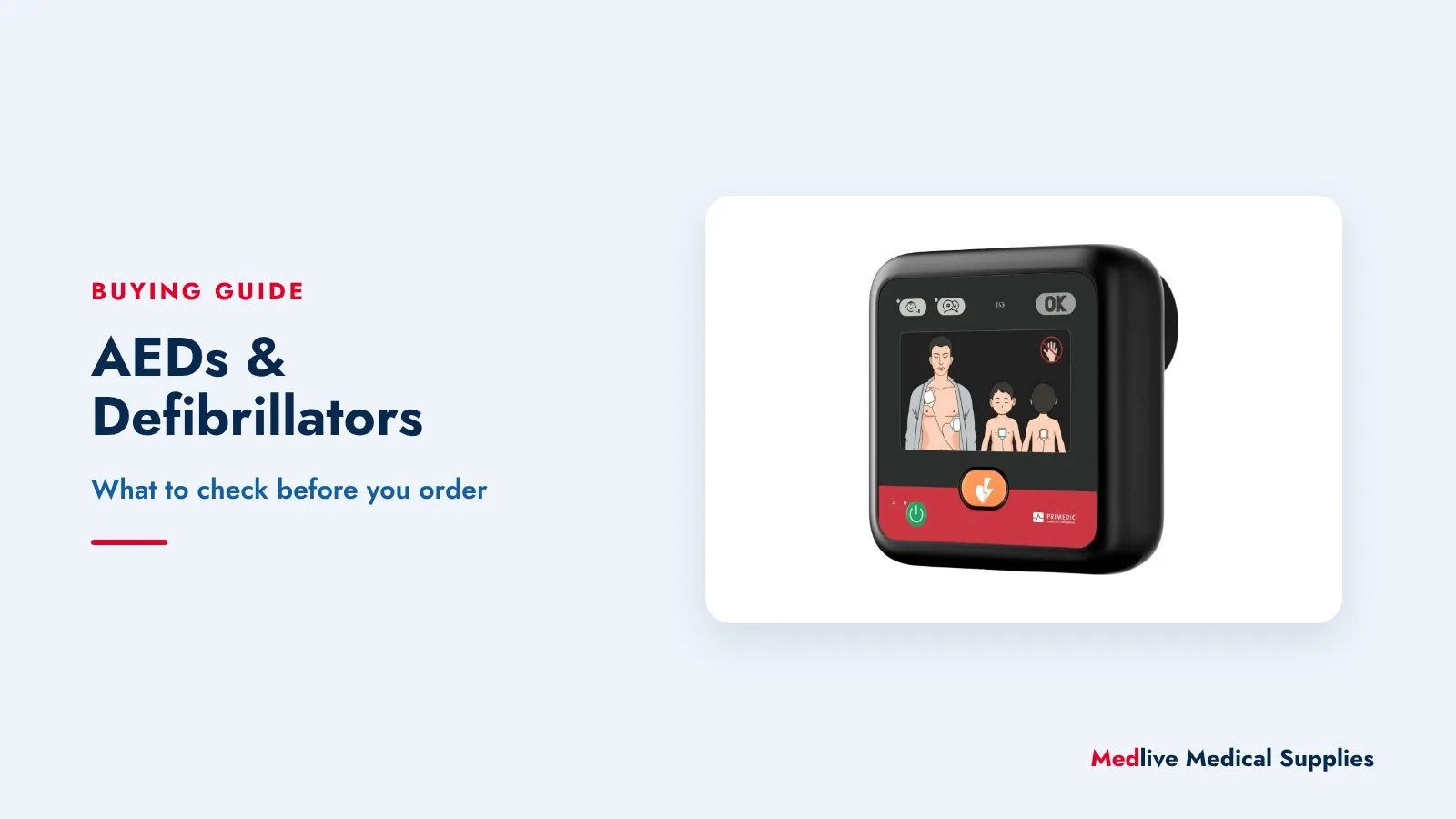
An automated external defibrillator (AED) is designed to be used in the first minutes of a sudden cardiac arrest, often by someone who is not a healthcare professional. Professional defibrillators are used by trained clinical teams in ambulances, emergency departments and wards. This guide explains the differences, the features to compare, the running costs that are easy to overlook and how to plan placement and training. Clinical use should always follow current resuscitation guidelines, your organisation’s protocols and the manufacturer’s instructions for use.
1. Public-access AED or professional defibrillator?
- Public-access AEDs analyse the heart rhythm themselves and give spoken or visual instructions, so trained lay responders can use them. They suit offices, schools, gyms, shopping centres, places of worship, factories, clinics and vehicles. The AEDs and defibrillators range includes, for example, the HeartSave myPAD Automated External Defibrillator (AED), the Rescue SAM 4.0 Automated External Defibrillator and the i-PAD CU-SP1 Automated External Defibrillator.
- Manual defibrillator-monitors display the ECG and let a trained clinician decide on and deliver therapy. They are used in hospitals and by emergency medical services, and may include additional monitoring functions. The range includes, for example, the Defibrillator Monitor Lifegain CU-HD1 Manual. Confirm the exact functions with the manufacturer’s specification sheet before ordering.
If the device will be used by staff without clinical training, choose an AED. If it is for a resuscitation team, discuss requirements with the clinicians who will use it.
2. Fully automatic or semi-automatic?
Both types analyse the rhythm and decide whether a shock is advised. The difference is what happens next:
- Semi-automatic AEDs prompt the rescuer to press a shock button.
- Fully automatic AEDs deliver the shock without a button press, after prompting everyone to stand clear. The range includes, for example, the Saver One Fully Automatic AED.
Some organisations prefer fully automatic units for responders who may hesitate; others prefer the rescuer to stay in control of the moment the shock is delivered. Choose one type across your sites where possible, so training is consistent.
3. Adult and paediatric use
If children may be treated, for example in schools, sports clubs and clinics, check how the AED handles paediatric patients. Some models use separate paediatric pads, others have a child mode or key. Ask what the model offers, whether paediatric pads are an additional purchase, and train responders on when to use them according to the manufacturer’s instructions.
4. Consumables and total cost of ownership
The purchase price is only part of the cost. Electrode pads and batteries have expiry dates and must be replaced after use or when they expire, whichever comes first. Before choosing a model, ask:
- What is the shelf life of the pads and the battery, and what do replacements cost?
- Are adult and paediatric pads both available for this model? Replacement pads are model-specific; for example, the AED Replacement Pads Adult AED 7000 are made for a particular AED.
- Does the unit run a self-test, and how does it show a fault or low battery?
- Does it store event data, and how is that data downloaded after use?
Budget for at least one spare set of pads per unit, so the AED can be returned to service immediately after use.
5. Placement, cabinets and signage
An AED only helps if it can be found and reached quickly. Good practice includes:
- Placing units where people gather or where risk is higher, and close enough that a responder can fetch one quickly.
- Mounting the unit in a visible, unlocked location, with clear signage showing where it is.
- Using a wall cabinet to protect it from dust, damage and tampering. The range includes, for example, the AED Wall-Mounted Alarm Cabinet.
- Keeping the unit within the temperature range in the manufacturer’s instructions, which matters for outdoor or unconditioned locations.
- Telling staff, security and reception where every unit is.
6. Training and maintenance
People are more likely to use an AED confidently if they have practised. A training unit, for example the AED Trainer XFT 120C Training Device, simulates the prompts of an AED without delivering a shock, so staff can practise safely and repeatedly. Combine practice with a recognised first aid and CPR course.
Assign a named person to check each AED regularly. Typical checks include the status indicator, the expiry dates of pads and battery, the condition of the cabinet and whether the unit is still in its place. Keep a simple log, and follow the manufacturer’s maintenance schedule.
7. Common mistakes to avoid
- Buying one AED for a large site where it cannot be reached quickly.
- Locking the AED away or hiding it in an office.
- Forgetting expiry dates on pads and batteries.
- Not buying paediatric pads where children are present.
- Not checking the supplier. Read how to check a medical device supplier with SAHPRA.
8. How to order from Medlive
Browse the AEDs and defibrillators sub-category or the full Emergency & First Aid department. For first aid kits and trauma supplies, see our emergency and first aid buying guide.
In South Africa, products with verified prices show ZAR prices including VAT and can be added to the cart. Customers in other countries see “Price on request (USD)” and can submit a Request a Quotation; freight and import paperwork are confirmed on the quotation. Equipping several sites? Use Bulk Orders, or Tender Enquiry for institutional and government requirements. Payment is by EFT once the final total has been confirmed in writing.