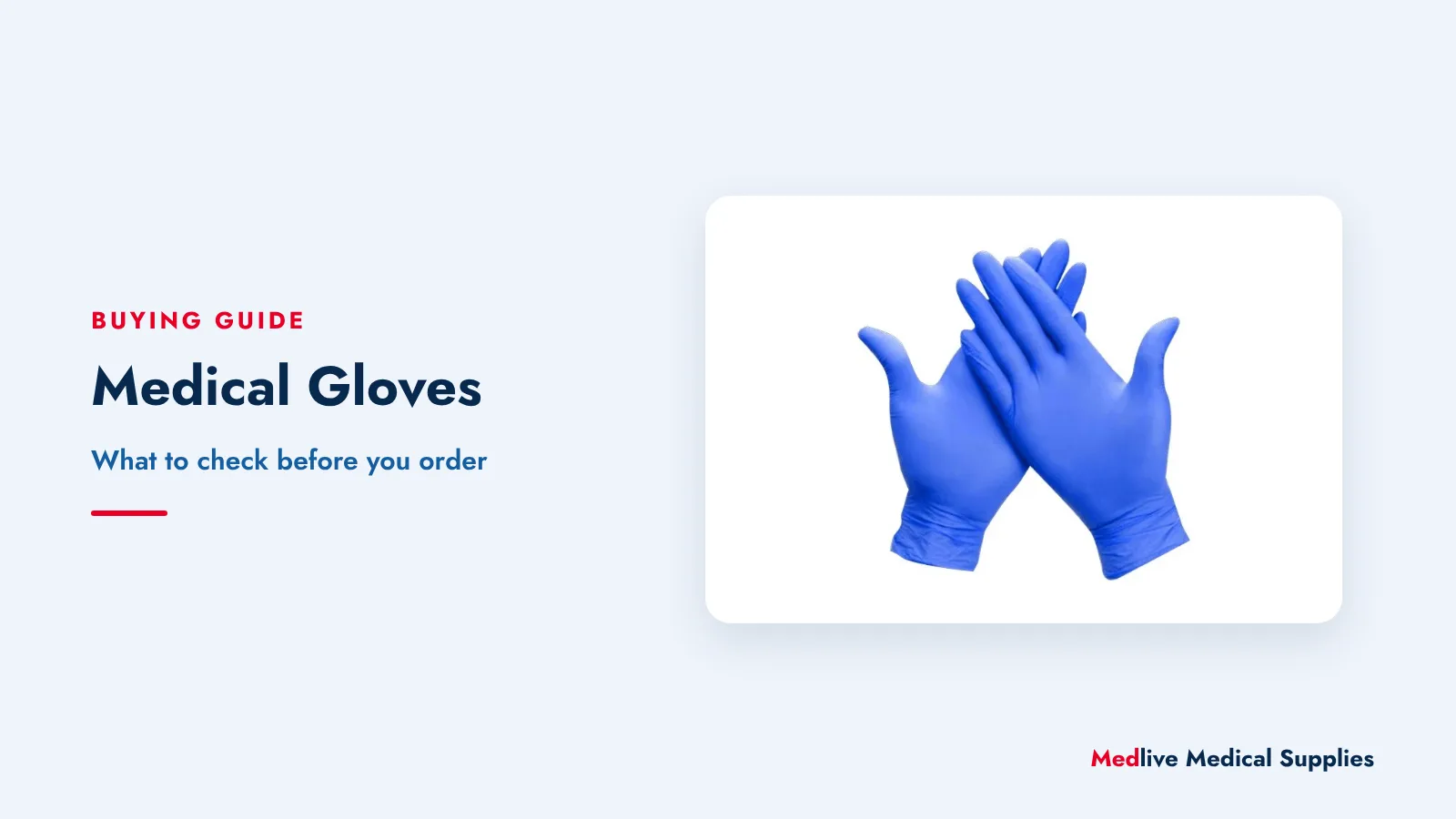
Gloves are among the most heavily used items in any healthcare setting, and small differences in material, fit and quality add up quickly across thousands of glove changes a month. This guide goes deeper than our general PPE guide and explains how to choose and plan supplies from our medical examination and surgical gloves range.
1. Examination gloves or surgical gloves
- Examination gloves are single-use gloves for routine examinations, procedures and handling where sterility is not required. They are usually sold non-sterile in boxes with mixed left and right hands, in sizes such as small, medium and large. Examples in the range include Nitrile Examination Gloves – Powder Free (Box 100) Medium and Vinyl Examination Gloves – Box 100.
- Sterile and surgical gloves are individually packed in pairs, sized by number (for example 7.0 or 7.5) and shaped for each hand. They are used for surgery and procedures that require a sterile field. Examples include Sterile Gloves Latex – Pairs Box 50 Size 7.0 and Surgical Gloves Latex 7.5 Box 50 Pairs.
Which glove is required for a particular task is a clinical and infection-control decision. Follow your facility’s protocols.
2. Nitrile, latex or vinyl
| Material | Main points to consider |
|---|---|
| Nitrile | Synthetic and latex-free, so it avoids natural rubber latex allergy. Widely used for general examination work. Check the manufacturer’s information on chemical resistance if staff handle disinfectants or other chemicals. |
| Latex (natural rubber) | Flexible with a close fit and good touch sensitivity, which is why it remains common for surgical gloves. Not suitable for people with a latex allergy. |
| Vinyl | Latex-free and usually lower cost. Looser fit and less stretch, so it is generally chosen for short, low-risk tasks. |
3. Powder-free or powdered
Powder makes gloves easier to put on, but it can carry latex proteins into the air and leave residue on hands and surfaces. Many facilities have moved to powder-free gloves for these reasons. If you still buy powdered gloves, for example Latex Examination Gloves Powdered Box 100, check that this matches your facility’s policy and the tasks they will be used for.
4. Latex allergy
Latex allergy can affect both staff and patients. A practical approach is to:
- Stock latex-free examination gloves (nitrile or vinyl) as standard, or at least in every area where a latex-allergic person may be treated or may work.
- Keep a latex-free sterile option available if your facility uses latex surgical gloves.
- Label storage clearly so latex and latex-free stock are not mixed.
- Ask staff to report suspected reactions through your occupational health process.
5. Standards and quality: EN 455 and AQL
Medical gloves for single use are commonly tested to the European EN 455 series. In general terms, Part 1 covers freedom from holes, Part 2 covers physical properties such as dimensions and strength, Part 3 covers biological evaluation (for example powder residue, endotoxins on sterile gloves and leachable proteins in latex gloves), and Part 4 covers the determination of shelf life.
The freedom-from-holes test uses statistical batch sampling with an acceptable quality level (AQL). A lower AQL means a stricter limit on defective gloves. Examination gloves are commonly tested to AQL 1.5, and surgical gloves to the stricter AQL 0.65. When comparing gloves, ask for the manufacturer’s documentation showing the standards and AQL they are tested to, rather than relying on a description alone.
6. Sizing and fit
- Gloves that are too tight tire hands and tear more easily; gloves that are too loose reduce dexterity and grip.
- Most teams need several examination sizes. Ask staff which size they wear before placing a large order.
- Surgical glove sizes are numbered, and surgeons often have a preferred size. Keep a range of sizes in theatre stock.
- Check the glove length if cuffs need to cover gown sleeves or wrists for the task.
7. Planning quantities and monthly usage
Examination gloves are commonly packed in boxes of 100, with several boxes to a carton, and sterile gloves in boxes of pairs. To plan supply:
- Count glove changes per patient contact and multiply by daily patient numbers and working days. Remember that one examination uses two gloves.
- Split the total by size, using your staff size list.
- Add a buffer for outbreaks, outreach campaigns and any lead time on deliveries, and agree a minimum stock level that triggers a reorder.
- Store gloves away from heat and direct sunlight, and use older stock first. Check the expiry date on each box.
Use our clinic supplies checklist to plan gloves alongside other consumables. For masks, gowns and the wider PPE range, see our PPE and infection control buying guide.
8. How to order from Medlive
Browse the gloves sub-category or the full PPE & Infection Control department. In South Africa, products with verified prices show ZAR prices including VAT and can be added to the cart. Customers in our other markets see “Price on request (USD)” and can submit a Request a Quotation; freight and import paperwork are confirmed on the quotation.
For carton quantities and regular resupply, use Bulk Orders or Quick Order. Hospitals, NGOs and government buyers can submit requirements through Tender Enquiry. Freight is confirmed for each order, and payment is by EFT once the final total has been confirmed in writing.