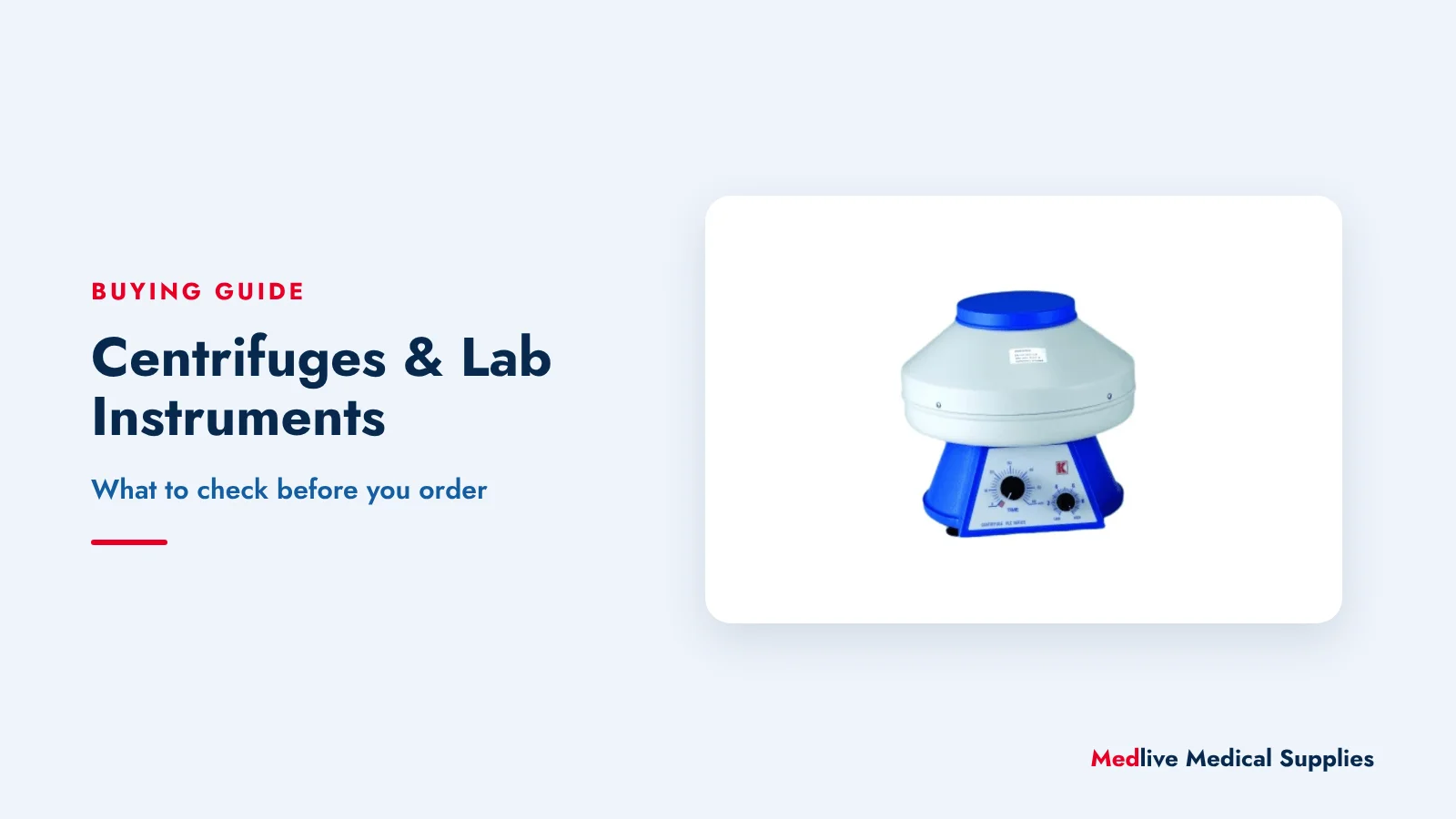
Bench instruments are the workhorses of clinic and hospital laboratories, research facilities and teaching labs. Choosing well means matching each instrument to the tubes, samples and workload you actually have, and planning for the bench space, power and calibration it will need. This guide covers centrifuges, urine analysers, balances, mixers, stirrers and water baths. Test methods and procedures should always follow your laboratory’s standard operating procedures and the manufacturer’s instructions for use.
Browse the full range on our laboratory instruments page.
1. Centrifuges
Our range includes, for example, the Bench Top Centrifuge, Low-Speed Clinical Centrifuge Table-Top and Micro Haematocrit Centrifuge – 12,000 RPM. When comparing models, check:
- Tube sizes and rotor compatibility: list the tubes you use, by volume and dimensions, and confirm that the rotor, buckets or adaptors accept them. A centrifuge that cannot hold your tubes is of no use, however good its other specifications.
- Number of places: match the rotor capacity to your typical batch size, allowing for the need to balance loads.
- Speed and RCF: RPM (revolutions per minute) describes how fast the rotor turns. RCF (relative centrifugal force, given as a multiple of g) describes the force on the sample, and it depends on both the speed and the radius of the rotor. Two centrifuges running at the same RPM can apply different forces if their rotors differ in size, so where a procedure specifies a g-force, check that the centrifuge and rotor can reach it.
- Safety features: look for a lid lock that prevents opening while the rotor is turning, and imbalance detection that stops the run if the load is uneven.
Always balance loads by placing tubes of equal mass opposite each other, using balance tubes where needed, as the manufacturer instructs.
Haematocrit centrifuges are a specialised type designed for capillary tubes. Budget for compatible capillary tubes, sealant and a haematocrit reader or reading chart alongside the centrifuge.
2. Urine analysers
Semi-automated urine analysers read reagent strips more consistently than visual reading and record the result. Examples are the Mission Urine Analyser U120 Automated and Contec Urine Analyser BC400 + 100 Strips.
- Strip compatibility: analysers are designed to read specific strips. Always order the strips listed by the manufacturer for your analyser model.
- Throughput: estimate samples per hour at your busiest time and compare that with the analyser’s stated capacity.
- Printing and connectivity: check whether results print on the device and whether the analyser can send data to a laboratory information system. Ask us to confirm connectivity options before ordering if this matters.
3. Laboratory balances
Two figures describe a balance: capacity, the maximum load, and readability, the smallest increment displayed. The Electronic Laboratory Balance – 600g, 0.01g Precision, for example, weighs up to 600g and displays to 0.01g. Choose readability according to the smallest quantity you need to weigh, and capacity according to the heaviest container plus sample.
- Plan for calibration weights or a calibration service, and check calibration at the intervals your quality system requires.
- A draught shield helps at fine readabilities, where air movement affects readings.
- Place the balance on a stable, level bench away from doors, fans and vibration, and use the levelling feet and bubble indicator if fitted.
4. Mixers, stirrers and water baths
- Vortex mixers, such as the Vortex Mixer Lab, mix individual tubes quickly. Check the speed control and which tube sizes the head accepts.
- Magnetic stirrers, such as the Magnetic Stirrer Laboratory, mix liquids in beakers and flasks using a stir bar. Check the maximum volume and whether the model heats.
- Water baths, such as the Water Bath Shaking Incubator 20L, hold samples at a set temperature. Compare capacity, temperature range and stability as given in the manufacturer’s specification, and whether shaking is needed.
5. Bench space, power and support
- Measure the bench space, including clearance around vents and room to open lids.
- Check the voltage and plug type, and plan for a UPS or backup supply where power interruptions could spoil a run or damage an instrument.
- Ask how each instrument is serviced and whether calibration certificates are available, and keep them with your quality records.
- Run quality control at the frequency your procedures require, and train every user before the instrument goes into service.
Most instruments need consumables such as tubes, strips and pipette tips, which you can find in our laboratory consumables range. For microscopy, see our microscopes range.
6. Common mistakes to avoid
- Choosing a centrifuge by RPM alone when the procedure specifies a g-force.
- Buying a centrifuge before confirming it accepts your tubes.
- Ordering urine strips that do not match the analyser.
- Choosing a balance with finer readability than you need, and then placing it where draughts make it unstable.
- Forgetting to budget for calibration, servicing and backup power.
How to order from Medlive
Compare instruments on our laboratory instruments page, or explore the wider Laboratory Equipment department. Our laboratory equipment buying guide covers the rest of the department.
Customers in South Africa see verified prices including VAT and can add products to the cart. Customers in other African countries see Price on request (USD); use Request a Quotation and we will confirm pricing, freight and import paperwork on the quotation. For several instruments or multi-site laboratories, use bulk orders, and for formal procurement with specifications and closing dates, use our tender enquiry service. Payment is by EFT once the final total has been confirmed in writing.