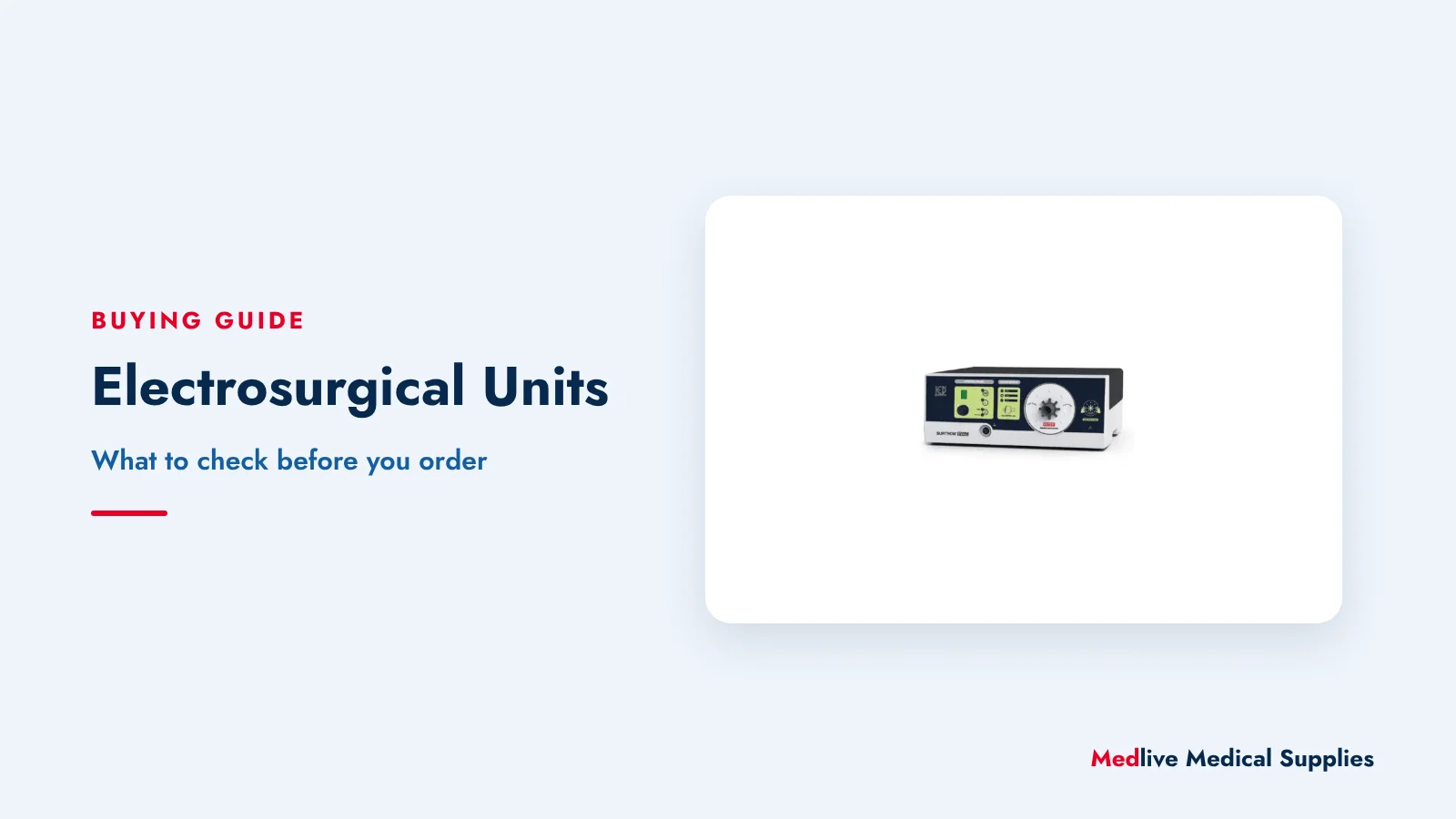
An electrosurgical unit (ESU), usually called a diathermy unit, is one of the most used pieces of equipment in theatres, day clinics and many consulting rooms. Choosing one is less about the box itself and more about matching power, modes and accessories to the procedures your clinicians actually perform. This guide explains what to decide, what the specifications mean and how to order. You can browse the full range in our electrosurgery and diathermy category.
1. Start with the procedures, not the generator
Before comparing models, list the procedures the unit will support and who will use it. A dermatology or general practice room doing minor skin procedures has very different needs from a general theatre list. Ask the surgeons, anaesthetists and theatre manager to agree the requirement in writing. Clinical technique and settings are always a matter for the clinician, the facility’s protocols and the manufacturer’s instructions for use (IFU).
2. Monopolar and bipolar in general terms
In monopolar electrosurgery, current flows from an active electrode (for example a pencil or handle with a blade or ball tip) through the patient to a separate return electrode, often called the patient plate. In bipolar electrosurgery, both electrodes are in the instrument itself, typically a pair of bipolar forceps, so current passes only through the tissue held between the tips.
Some units are monopolar only, for example the Surtron 50D Electrosurgical Unit – Monopolar, while others offer both outputs. If your surgeons want bipolar, confirm that the unit has a bipolar output before you order bipolar forceps and cables.
3. Power output and modes
Power is expressed in watts. Lower-power units are generally intended for consulting rooms, dermatology and minor surgery, while higher-power units are aimed at theatre work. The range includes, for example, the Surtron 80 Diathermy ESU Unit, the Surtron Diathermy 200W and the Surtron Flash 200 Diathermy Unit. Buying more power than you need adds cost without benefit; buying too little limits what the unit can be used for.
Most units offer cutting, coagulation and blended modes, but the names, number of modes and settings differ between manufacturers. Ask for the manufacturer’s specification sheet and compare like with like: maximum output per mode, monopolar and bipolar outputs, and any memory or preset functions.
4. Return electrodes, safety features and smoke
Monopolar use requires a return electrode. Check which patient plates the unit accepts (single-use or reusable, adult or paediatric), whether the unit has a return electrode monitoring feature, and what the manufacturer specifies for plate type and placement. Order plates that the manufacturer lists as compatible and follow the IFU every time. Other features worth comparing include audible activation tones, alarm indicators, and how easily staff can read and adjust settings during a procedure.
Electrosurgery produces surgical smoke. Some facilities manage this with a separate smoke evacuator; some units integrate evacuation, for example the Surtron Evac Diathermy Unit. Discuss smoke management with your infection prevention and occupational health teams, and confirm which filters and tubing the system uses and how often they need replacing, so that running costs are included in your budget.
5. Accessories must match the unit
Handles, electrodes, cables and foot switches are not universal. Connectors and pin configurations vary between brands and sometimes between models. Typical accessories in our diathermy range include, for example:
- Diathermy Handle Reusable with Finger Switch
- Diathermy Electrode Ball-Tip Reusable
- Diathermy Bipolar Forceps Curved – Reusable
- Diathermy Bipolar Forceps Cable 3m – Reusable
- Diathermy Foot Switch Waterproof
When you request a quotation, tell us the make and model of your existing unit so that compatibility can be confirmed before you order. Bipolar forceps are also used alongside general instruments; see our surgical instruments buying guide for planning instrument sets.
6. Reprocessing, servicing and training
Reusable handles, electrodes, forceps and cables must be cleaned, inspected and sterilised according to the manufacturer’s IFU, including any limit on the number of reprocessing cycles. Check that your sterilisation equipment suits the items; our autoclave buying guide covers this. Damaged insulation on cables and instruments should be identified during inspection and the item withdrawn.
Plan for user training when a new unit arrives, and for routine servicing and electrical safety testing by qualified technicians according to the manufacturer’s recommendations and your facility’s maintenance programme. Ask about servicing arrangements, spares and terms at quotation stage, so they are confirmed in writing rather than assumed.
Common mistakes to avoid:
- Ordering accessories without checking connector compatibility with the generator.
- Choosing a theatre-level unit for a consulting room, or a low-power unit for theatre lists.
- Forgetting the running costs of return electrodes, single-use tips and smoke evacuation filters.
- Leaving training and maintenance planning until after delivery.
How to order from Medlive
Browse the electrosurgery and diathermy category or the wider Surgical Supplies department, and for the full surgical range see our surgical supplies buying guide. Customers in South Africa see ZAR prices including VAT where a verified price is available; customers in other African countries see Price on request (USD), and freight and import paperwork are confirmed on the quotation. For equipment specifications and accessory compatibility, request a quotation. For multiple units or theatre accessory sets, use bulk orders, and hospitals, NGOs and government buyers can submit a tender enquiry. Payment is by EFT once the final total, including freight, is confirmed in writing.