Disposable protective clothing and face masks are among the highest-volume items a healthcare facility buys. Getting the mix right means staff have the correct item for each task, stock does not run out, and money is not spent on more protection than a task needs. This guide covers aprons, gowns, coveralls, caps, shoe covers, face masks and goggles. For the wider range, see our PPE and infection control buying guide.
1. Choose by task and risk, following your policy
The starting point is always your facility’s infection prevention and control policy, which sets out what PPE is worn for which tasks. Purchasing should follow that policy rather than replace it. A useful approach is to list your common tasks, such as routine ward care, cleaning, procedures with a splash risk, isolation care and theatre work, and note the items the policy requires for each. That list becomes the basis of your order.
2. Aprons, gowns and coveralls
These three items give increasing body coverage. The gowns, drapes and coveralls range includes, for example:
- Aprons, such as Disposable Protective Aprons and LDPE Disposable Aprons 100 Pack. Plastic aprons protect the front of clothing during tasks where the policy calls for them, such as some personal care and cleaning tasks.
- Gowns, which also cover the arms and are used where the policy requires wider coverage.
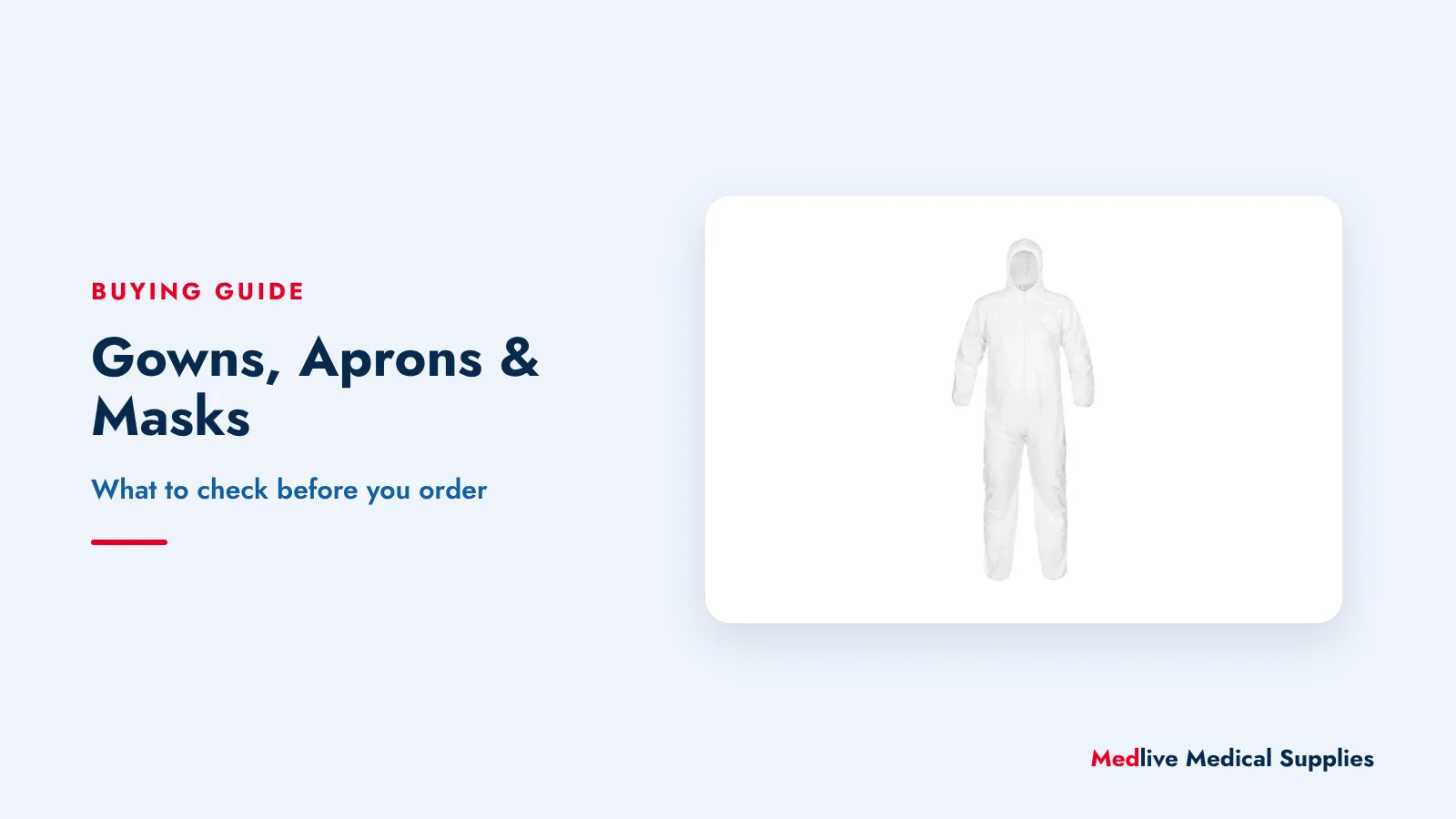
- Coveralls, such as the Disposable Coverall – Non-Woven, 50gsm, which cover the whole body. The gsm figure is the weight of the fabric in grams per square metre; compare it only alongside the manufacturer’s stated protection level and intended use.
Sizing matters. Gowns and coveralls that are too small tear or restrict movement, and those that are too large get in the way. Look at your staff profile and order a sensible mix of sizes rather than a single size.
3. Caps, shoe covers and eye protection
Caps and shoe covers complete the set for theatres, clean areas and some laboratory and food-handling settings. Examples in the range include the Disposable Surgical Cap 100 Pack and Shoe Covers PP Non-Slip – Box 100 Pairs. A non-slip sole is worth considering where floors may be wet. Where your policy calls for eye protection against splashes, goggles such as Safety Goggles Anti-Splash – Pair can be worn; check whether they fit over prescription spectacles and how the manufacturer says they should be cleaned or disposed of.
4. Face masks and respirators
Medical face masks and respirators are different categories and should not be confused. The masks and respirators range includes, for example, the 3-Ply Surgical Face Mask – Box 50 and the 3 Ply Face Mask with Ear Loops – Pack of 50.
- Medical (surgical) face masks are loose-fitting masks with several layers. In Europe they are tested to the standard EN 14683, which classifies them as Type I, Type II or Type IIR; Type IIR masks are also tested for resistance to fluid splashes. If your policy specifies a type, ask us for the manufacturer’s documentation for the mask you are considering.
- Respirators, such as N95 or FFP2 types, are designed to seal tightly to the face. They are a separate category, and wearers are normally fit tested under the employer’s occupational health and safety programme. Follow your occupational health guidance before buying respirators.
Ear-loop masks are quick to put on and take off; tie-on masks can be adjusted for a closer fit and are often preferred in theatres. Choose according to your policy and staff preference.
5. Estimating quantities
Most of these items are single use, so consumption adds up quickly. To estimate monthly needs:
- Count the tasks per shift that need each item and multiply by shifts and days.
- Add a margin for outbreaks, busy periods and new staff.
- Convert to boxes using the pack quantity, for example boxes of 50 or 100.
- Store stock in a clean, dry place away from direct sunlight, and use older stock first.
Gloves are usually ordered at the same time. See our medical examination gloves buying guide for sizing and material choices.
6. Common mistakes to avoid
- Treating a surgical mask as a respirator, or buying respirators without a fit testing plan.
- Ordering one size of gown or coverall for all staff.
- Comparing products on price per box without checking the number of pieces in each box.
- Running down stock before reordering, leaving no buffer for a busy month.
7. How to order from Medlive
Browse the PPE and infection control department and the gowns, drapes and coveralls category. Customers in South Africa see verified ZAR prices including VAT where available and can add items to the cart. Customers in other African countries see Price on request (USD) and can request a quotation; freight and import paperwork are confirmed on the quotation. For monthly or large-volume supplies, use bulk orders, and hospitals, NGOs and government departments can submit requirements through a tender enquiry. Payment is by EFT once the final total, including freight, has been confirmed in writing.