Exercise and rehabilitation equipment ranges from a single roll of resistance tubing to a full Pilates reformer. Physiotherapy practices, biokinetics centres, Pilates studios, hospital rehab wards and home users all buy from the same exercise and rehab equipment range, but their priorities differ. This guide explains what to decide before you order, what the main specifications mean and how to avoid common purchasing mistakes.
1. Start with who will use the equipment and where
Before comparing products, write down three things: the patient groups you see (post-operative, older adults, sports injuries, neurological, paediatric), the space you have, and how many people will use each item per day. A busy practice needs equipment that survives repeated cleaning and enough duplicates; a studio needs matching sets so classes run smoothly.
Clinical choices, such as which exercises suit a particular patient, belong to the treating physiotherapist or biokineticist. This guide covers purchasing only.
2. Resistance bands and tubing
Bands and tubing are the most frequently restocked items in most practices. The range includes, for example, the TheraBand Band Loop Blue and eXertube Resistance Tubing Red 30m.
- Colour coding is brand-specific. Each manufacturer uses its own colour sequence for resistance levels, so a red band from one brand is not necessarily equal to a red band from another. Compare resistance within one brand and keep to one brand per clinic where possible, so patients and staff are not confused.
- Bulk rolls or pre-cut lengths. Long rolls let a practice cut a length for each patient to take home, which usually works out more economical for high-volume clinics. Pre-cut bands and loops suit home users and studios that want ready-to-use pieces.
- Latex or latex-free. If you treat patients with latex sensitivity, ask us to confirm the material of a specific product before ordering, and label latex-free stock clearly in the clinic.
3. Small rehab items: hand exercisers, balance, balls, mats and weights
Hand and finger exercisers come in graded sets, for example the Digi-Flex Hand and Finger Exerciser Set of 5, which lets a therapist progress resistance without replacing the whole unit.
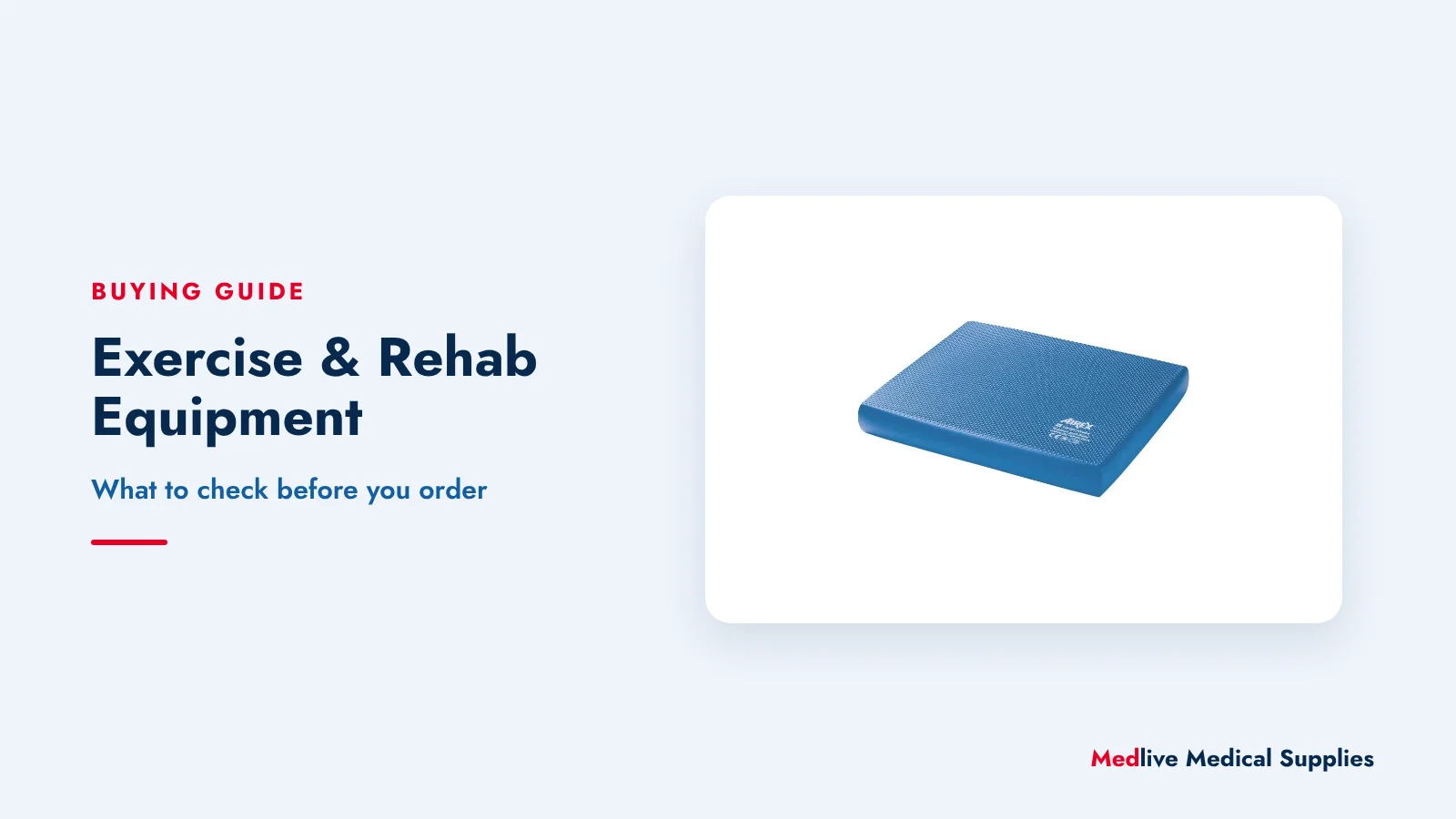
Balance pads and exercise balls carry load, so check the maximum user weight stated by the manufacturer before buying. The range includes items such as the Airex Balance Pad Elite and the Synergy 120cm Anti-Burst Exercise Ball. For balls, match the diameter to the users’ height using the manufacturer’s sizing chart, and prefer anti-burst construction for clinical settings.
Mats should be chosen for thickness, size and how easily the surface can be wiped down between patients. A larger mat, for example the Vinyl Exercise Mat 210cm x 120cm x 2.5cm, suits plinth-level or floor work in a treatment room, while thinner roll-up mats suit classes and home programmes.
Weights (dumbbells, cuff weights and weighted balls) are best bought as a graded set, with extra units in the most-used weights.
4. Larger equipment: stairs, pedal exercisers, bikes and reformers
Larger items need more planning because they take floor space and are harder to return or move. The rehab equipment category includes, for example, the Stairs 90 Degree | Rehab Stairs, the HT Digital Pedal Exerciser, the Dyaco ReActiv 4.0 R Recumbent Bike and the Balanced Body Allegro 1 Reformer with Tower, Mat Conversion and Legs.
- Floor space and access. Measure the room, doorways and any stairwell the item must pass through. Allow clear space around the equipment for the patient and therapist.
- Ceiling height. Reformers with towers and some exercise positions need extra height; check the manufacturer’s dimensions.
- Assembly. Ask whether the item arrives assembled, who assembles it and what tools are needed.
- Spare parts and consumables. Reformer springs, ropes and straps wear with use. Ask about spare parts when you request the quotation, so the studio is not stopped by one worn spring.
Continuous passive motion (CPM) devices, for example the Kinetec Maestra Hand & Wrist CPM, are used under a clinician’s prescription and set-up. Buy them where your service has the trained staff to apply them, and follow the manufacturer’s instructions for use.
5. Cleaning, storage and safety checks
Shared equipment touches skin and must be cleaned between patients. Before you buy, check what the manufacturer says about compatible cleaning products, because some disinfectants can damage rubber, foam or vinyl surfaces. Store bands and tubing out of direct sun and heat, and inspect them regularly for nicks or thinning. Retire any band, ball or pad that shows damage. For larger machines, keep a simple log of checks and servicing.
6. A starter kit versus restocking
A new practice or studio usually needs a starter set: bands or tubing in several resistance levels, a hand exerciser set, a balance pad, one or two exercise balls in different diameters, mats, a graded weight set, and possibly one larger item such as rehab stairs or a pedal exerciser.
An established practice mostly restocks consumable items: tubing rolls, pre-cut bands, mats that have worn and balls that have reached the end of their life. Keep a short list of the brands and resistance levels you already use so replacements match. Many practices also stock heat and cold packs; see our hot and cold therapy range.
For walking aids, wheelchairs and other mobility products, see our mobility and rehabilitation equipment buying guide.
How to order from Medlive
Browse the full exercise and rehab equipment range or the wider Mobility & Rehabilitation department. South African customers see verified ZAR prices including VAT where available and can add items to the cart. Customers in other African countries see Price on request (USD) and can request a quotation. Freight for large items such as reformers, bikes and rehab stairs is confirmed on the quotation, along with any import paperwork. For practice fit-outs, studio openings or repeat volume orders, use our bulk orders service. Payment is by EFT once the final total has been confirmed in writing.