Airway and resuscitation equipment is used in the most time-critical moments in healthcare, so it must be the right size, complete, compatible and ready. This guide covers the purchasing decisions for the airway and resuscitation range: what to look for, how the parts fit together and how to keep kits stocked. It is a buying guide only. This equipment is for use by trained people, in line with current resuscitation guidelines, your facility’s protocols and the manufacturer’s instructions for use.
1. Start with scope of practice
Buy for the skills of the people who will use the kit. A workplace first-aid team needs pocket masks and possibly a bag-valve-mask; an ambulance crew, emergency unit or theatre needs laryngoscopes, supraglottic airways and intubation accessories. Equipment that nobody on the team is trained to use adds cost without adding safety. Agree the kit list with the clinical lead before ordering.
2. Bag-valve-mask resuscitators
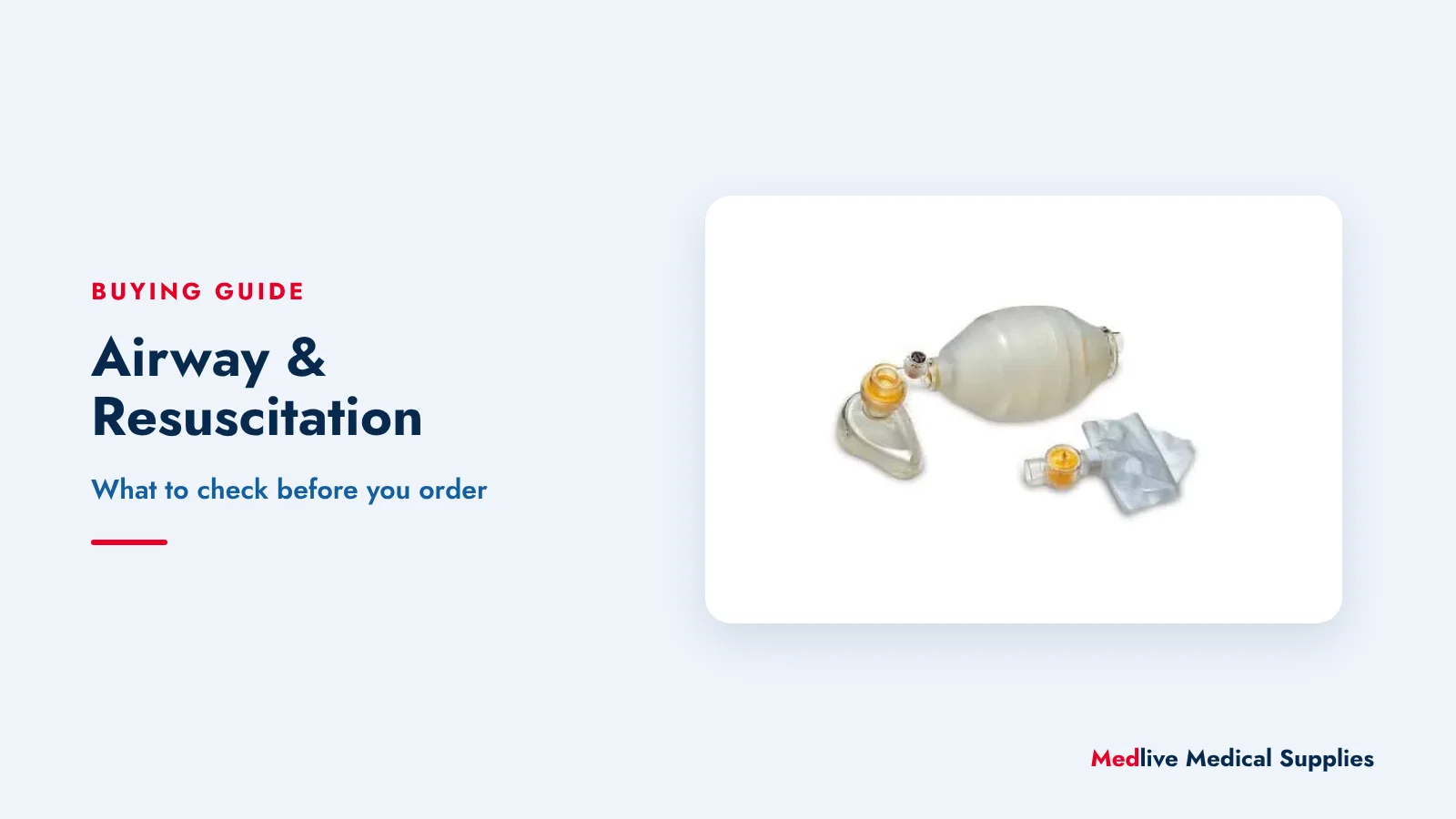
A bag-valve-mask (BVM) resuscitator delivers manual ventilation through a face mask or airway device. Key purchasing points:
- Size: adult, child and infant versions have different bag volumes. Examples in the range include the BVM Silicone Resuscitator Adult – Complete, the Silicone BVM Resuscitator – Child, the BVM PVC Resuscitator Infant – Single Use and the NEO-I Infant Resuscitator. Facilities that treat all ages need all sizes.
- Reusable or single-use: silicone BVMs are designed to be cleaned and reprocessed according to the manufacturer’s instructions; PVC BVMs are typically single-use. Reusable units cost more up front but less per use where reprocessing facilities exist; single-use units avoid reprocessing and suit ambulances and remote sites.
- Masks: check which mask sizes are included and order extra sizes where needed.
- Oxygen: confirm that an oxygen reservoir bag and oxygen tubing are included, and that the tubing connects to your oxygen supply.
- Accessories: if your protocols use a PEEP valve or filter, ask us to confirm compatibility with the specific BVM before ordering.
For trained first aiders, a pocket mask such as the CPR Pocket Resuscitator with Oxygen Inlet provides a barrier for rescue breaths and is small enough for a first-aid kit or vehicle.
3. Laryngoscopes
Laryngoscopes are sold as handles and blades, often in sets. Points to check:
- Blade type: Macintosh blades are curved; Miller blades are straight and are often used in paediatrics. The Laryngoscope Set – 3 Blade Miller Paediatric and the Laryngoscope Set Fibre Optic Adult – 4 Blades are examples of the sets in the range.
- Fibre-optic or conventional: in fibre-optic systems the light source is in the handle and light travels through the blade; in conventional systems the bulb sits on the blade. The two systems are generally not interchangeable, so match blades to handles.
- Power and spares: check battery size or rechargeable options, and keep spare batteries and lamps with every set.
Video laryngoscopes, for example the Video Laryngoscope CMS-GS1, display the view on a screen. When comparing models, ask about screen type, battery life and charging, blade sizes, and whether the blades or blade covers are single-use, as this sets the ongoing consumable cost.
4. Supraglottic airways and accessories
Supraglottic airways such as laryngeal masks are sized by patient weight according to the manufacturer’s sizing chart; the LMA Laryngeal Mask Airway Size 4 Adult is one example. Stock the range of sizes your protocols require, not only the most common adult size. Supporting items complete the kit:
- Magill forceps, for example Magill Forceps Adult – Stainless Steel, in the sizes your teams use.
- Tube holders and bite blocks, for example the ET Tube Holder Bite Block.
- Suction: airway management also depends on reliable suction. See the respiratory equipment department for suction units and consumables.
5. Building, checking and restocking a kit
- Organise kits by age group, with each size clearly labelled.
- Use a written checklist and check kits on a set schedule and after every use.
- Record expiry dates of sterile and single-use items and rotate stock.
- Replace single-use items immediately after use and reprocess reusable items before returning them to the kit.
- Pair airway kits with defibrillation equipment; see our AED and defibrillator buying guide.
6. Mistakes to avoid
- Buying only adult sizes for a facility that sees children and infants.
- Mixing laryngoscope handles and blades from incompatible systems.
- Forgetting spare lamps, batteries and oxygen tubing.
- Comparing reusable and single-use items on unit price alone instead of cost per use.
For the wider range, see our emergency and first aid equipment buying guide.
7. How to order from Medlive
Browse the airway and resuscitation products or the full emergency and first aid department. South African customers see verified ZAR prices including VAT where available; customers in other African countries see “Price on request (USD)” and can request a quotation, with freight and import paperwork confirmed on the quote. Use bulk orders to equip several vehicles or wards, and hospitals, emergency services and government buyers can submit a tender enquiry. Payment is by EFT once the final total is confirmed in writing.