Bandages are among the most frequently reordered items in any clinic, ward, school or first-aid room. Most buyers need a mix of types rather than one, because each bandage does a different job. This guide explains the main types in our bandages range, how sizes are described and how to plan pack quantities.
Which bandage to use on a particular patient, and how to apply it, is a clinical decision. Follow your facility’s protocols, your training and the manufacturer’s instructions for use. This guide covers purchasing only.
1. The main bandage types
| Type | Typical purchasing use |
|---|---|
| Conforming | Holding dressings in place |
| Crepe | Light support and retaining dressings |
| Cohesive (self-adherent) | Securing without clips or tape; sport and first aid |
| Tubular elasticated | Light support on limbs, sized by letter |
| Triangular | Slings and first-aid kits |
| Compression systems | Only as prescribed and applied by trained staff |
2. Conforming and crepe bandages
Conforming bandages are lightweight, stretchy bandages that mould to the body’s contours. Their main purchasing use is holding a dressing in place. They are usually bought in multi-packs, for example the Conforming Bandage 75mm x 4.5m – 10-pack.
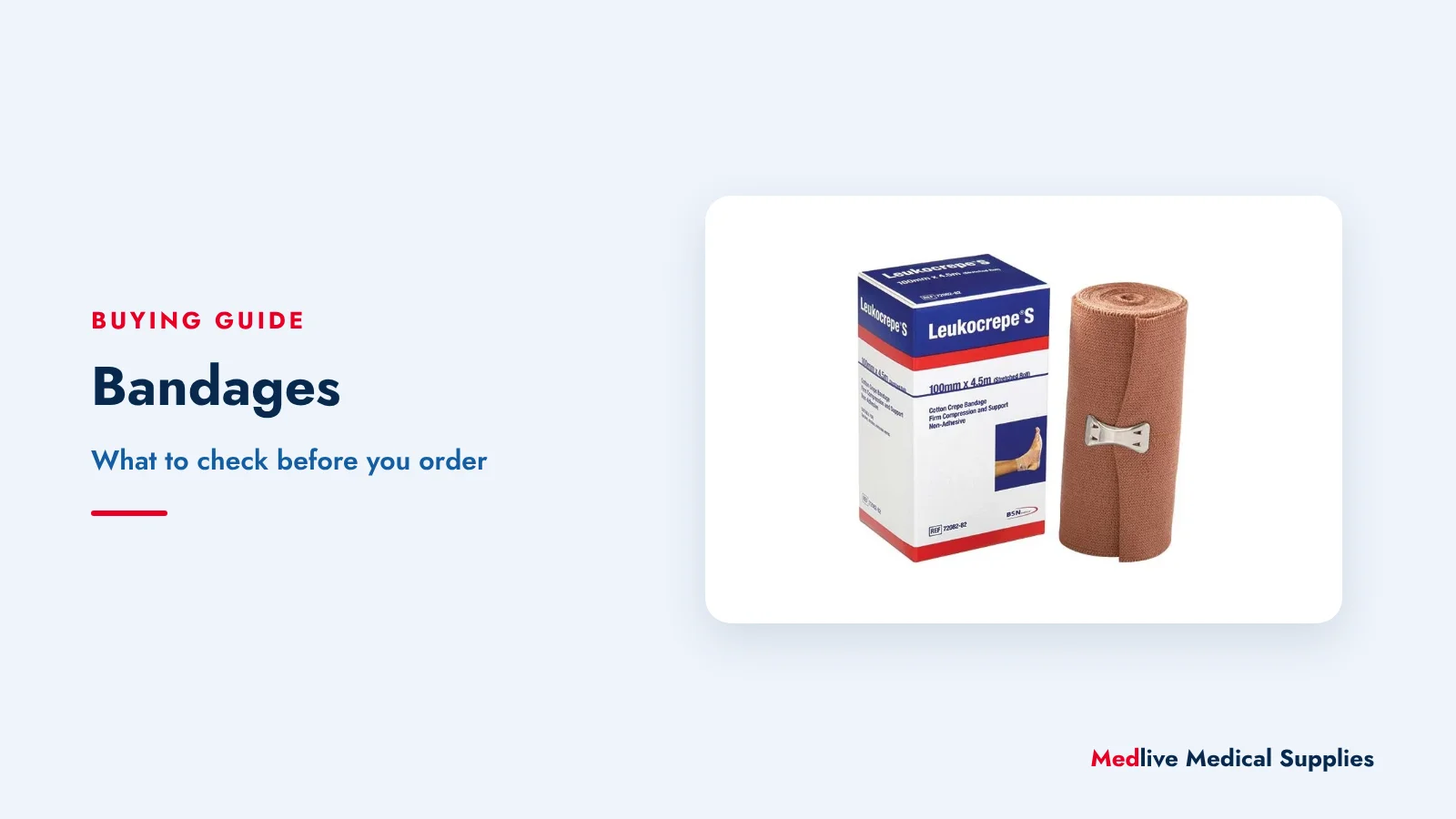
Crepe bandages are heavier, with a crinkled weave that gives more body. They are commonly bought for light support as well as retention. The range includes, for example, the Leukocrepe S Crepe Bandage 100mm x 4.5m. Crepe bandages are often fastened with clips or tape, so check whether clips are included or need to be ordered separately from our tapes and plasters range.
3. Cohesive (self-adherent) bandages
Cohesive bandages stick to themselves but not to skin or hair, so they need no clips or tape and can be torn by hand. They are popular with sports teams, physiotherapists and emergency kits. Examples in the range include the HT Cohesive Bandage Beige 7.5cm x 4.5m, the d3 Cohesive Bandage Black 7.5cm x 9m and the Athletic Cohesive Self-Adherent Bandage 50mm. BSN Co-Plus Beige 10cm x 2m is a further example.
Some cohesive bandages contain natural rubber latex and others are latex-free. If this matters for your patients or staff, ask us to confirm the material of the specific product before you order, and label latex-free stock clearly.
4. Tubular and triangular bandages
Tubular elasticated bandages are supplied on rolls and cut to length. They are sized by letter, for example Tubigrip Size D: 7.5cm x 10m. The letter corresponds to a limb circumference range set by the manufacturer, so always use that manufacturer’s sizing chart, and do not assume that letters match between brands. Clinics usually stock the few sizes that cover most of their patients.
Triangular bandages are used for slings and as general-purpose first-aid bandages. The Triangular Bandage Non-Woven with Safety Pins is an example; check whether pins are included in the pack you choose. Triangular bandages are a standard component of most first-aid kits, so they are a common restocking item. For guidance on kit contents, see our first-aid kits buying guide.
Compression bandaging for venous or lymphatic conditions is a specialised clinical intervention. Buy compression systems only where they will be prescribed and applied by trained staff, and follow the manufacturer’s instructions.
5. Understanding widths and lengths
Bandages are described as width x length, for example 100mm x 4.5m. As a general guide, narrower widths suit fingers, hands and wrists, middle widths suit arms, ankles and feet, and wider bandages suit knees, thighs and the trunk. Manufacturers usually give their own guidance for each width, and that should take priority.
Check whether a length is given as stretched or unstretched. A stretched length tells you how far the bandage reaches when extended, and can look longer than a product described by its relaxed length. Compare like with like before deciding which is better value.
6. Sterile or non-sterile, and pack sizes
Many retention and support bandages are sold non-sterile, because they are normally applied over a dressing rather than directly on an open wound. If a sterile product is needed under your protocol, check that the listing states it is sterile and individually packed. The dressing itself is chosen separately; see our dressings range.
Bandages are sold as singles, in boxes or packs of ten and in larger bulk quantities. Singles suit home users and topping up a kit. Boxes of ten suit clinics and schools. Bulk quantities suit hospitals, NGOs running outreach programmes and organisations restocking many first-aid kits at once.
7. Restocking and storage
- Keep a short list of the types, widths and brands you use, so replacements match what staff are trained on.
- Set minimum levels for high-use items such as conforming and crepe bandages and triangular bandages.
- Store bandages in a clean, dry place in their original packaging, and use older stock first.
- After each first-aid incident, replace what was used so kits stay complete.
For the full wound care range, including dressings, cleansing and closure products, see our wound care buying guide.
How to order from Medlive
Browse the bandages category or the wider Wound Care department. South African customers see verified ZAR prices including VAT where available and can add items to the cart. Customers in other African countries see Price on request (USD) and can request a quotation; freight and import paperwork are confirmed on the quotation. Hospitals, NGOs and schools ordering larger quantities can use our bulk orders service, and public-sector or institutional buyers can submit a tender enquiry. Payment is by EFT once the final total has been confirmed in writing.