Heat and cold are among the most widely used tools in physiotherapy practices, sports medicine, rehab wards and home care. The equipment ranges from a single instant ice pack in a kit bag to a multi-pack hydrocollator in a busy clinic. This guide explains the main product types in our hot and cold therapy range, what to check before buying and how stocking differs between a practice and a sports team.
Whether heat or cold is appropriate for a person, and for how long, is a decision for the treating practitioner. Always follow the manufacturer’s instructions for use, especially on application time and skin protection. This guide covers purchasing only and makes no treatment claims.
1. Hydrocollator units
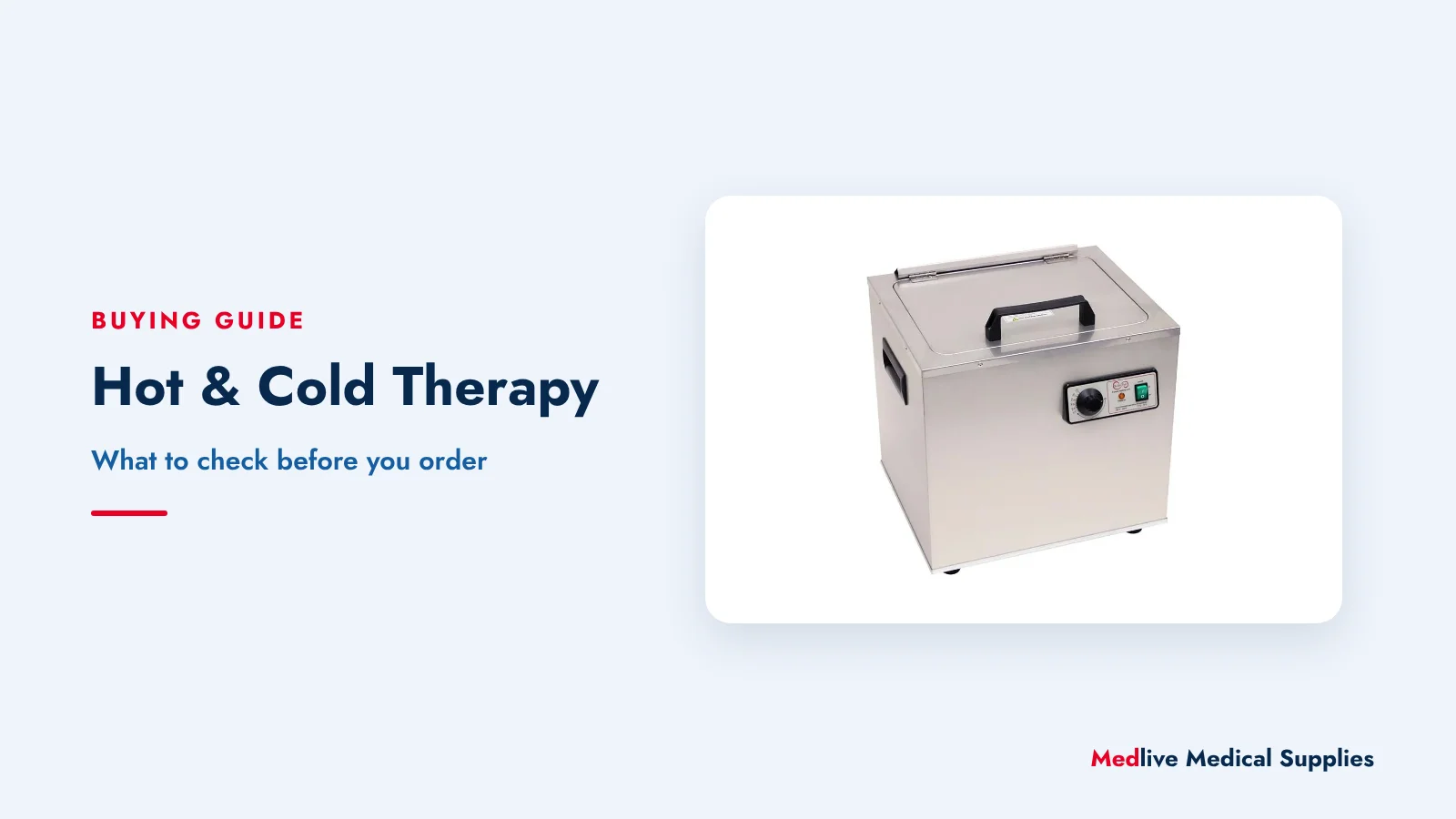
A hydrocollator is a thermostatically controlled water tank that keeps moist heat packs hot and ready to use. The range includes, for example, the Hydrocollator 6 Pack Unit. Before ordering, check:
- Pack capacity: how many packs the unit holds, and of which sizes. Match it to the number of patients treated at the same time.
- Water fill and draining: how much water the tank takes, how it is drained and how often the manufacturer recommends cleaning and descaling.
- Electrical supply: confirm the voltage and plug type suit your premises, and plan a dedicated socket near a sink if possible.
- Counter or floor space: check the dimensions and allow room to lift packs out safely.
2. Moist heat packs and terry covers
Moist heat packs are fabric packs filled with a material that absorbs water and holds heat. They come in shapes for different body areas, commonly standard, oversize, cervical (neck) and spinal sizes. The Moist Heat Pack Standard is one example. Check that the sizes you choose fit the hydrocollator you have.
Heat packs should always be used with a barrier between pack and skin, as set out in the manufacturer’s instructions. Thermal terry covers, for example the Thermal Terry Cover Standard, are made for this. Buy enough covers for laundering rotation: a practical rule is several covers per pack, so clean, dry covers are always available while others are in the wash.
3. Paraffin wax baths
Paraffin wax baths are used in hand therapy and some beauty and podiatry settings. The Keno Paraffin Wax Bath – 3kg is an example. Compare the wax capacity, the time the unit takes to melt and reach working temperature, and whether a thermostat and lid are included. Plan for refills of paraffin wax and any liners or mitts the manufacturer specifies, and keep the bath on a stable surface away from where people pass.
4. Cold packs, ice packs and ice bags
Cold products fall into a few groups:
- Reusable gel packs are kept in a freezer or fridge and reused. Some can also be warmed, for example the Relief Pak Cold ‘N Hot Pack Medium and the Mueller Reusable Cold/Hot Pack Regular 15.2cm x 22.8cm. They suit clinics and homes with freezer access.
- Instant ice packs are single-use packs activated by squeezing, such as the d3 Instant Ice Pack (Single). They need no freezer, which makes them practical for sports bags, events and first-aid kits.
- Ice bags and wraps hold real ice and are secured with a wrap, for example the Groovi Freeze Ice Bag with Wrap. They are refillable and useful at venues with an ice supply.
As with heat, follow the manufacturer’s guidance on barrier layers and application time.
5. Cryo cuffs and cold-compression systems
Cryo cuffs and cold-compression systems combine cold with a cuff shaped for a specific joint. Examples include the Ever Cryo: Shoulder Cryo Cuff and the HTT Cold Compression System Incl. Ankle, Knee, Leg, and Shoulder Cuff with Carry Bag. When comparing systems:
- Check which cuffs are included. Some systems come with several cuffs, others with one, and additional cuffs for other body areas are often sold separately.
- Check how the unit is powered and how it is filled with ice and water.
- Ask about replacement cuffs, tubing and connectors, because these parts wear with regular use.
- Consider whether the system will stay in the clinic or travel with a team; a carry bag helps for travel.
These systems are typically used under a practitioner’s direction, often after surgery or injury. Follow the clinician’s instructions and the manufacturer’s instructions for use.
6. Stocking a practice versus a sports team
| Setting | Typical core items |
|---|---|
| Physiotherapy or biokinetics practice | Hydrocollator, moist heat packs in several shapes, plenty of terry covers, reusable gel packs, possibly a paraffin wax bath and a cold-compression system |
| Sports team or club | Instant ice packs, reusable packs for a cooler box, ice bags and wraps, possibly a portable cold-compression system |
| Home user | One or two reusable hot/cold packs, used as instructed by their practitioner |
For practices, the ongoing costs are covers, replacement heat packs and wax refills. For teams, instant ice packs are the main recurring purchase, so plan quantities across the season.
7. Cleaning and care
Launder terry covers and wraps after each use, wipe gel packs with a cleaning product the manufacturer approves, and inspect packs for leaks or damage before use. Replace any pack that is split or worn. Drain and clean hydrocollators and wax baths on the schedule set out in their instructions.
Many practices buy heat and cold products alongside exercise equipment; see our mobility and rehabilitation equipment buying guide for the wider range.
How to order from Medlive
Browse the hot and cold therapy category or the wider Mobility & Rehabilitation department. South African customers see verified ZAR prices including VAT where available and can add items to the cart. Customers in other African countries see Price on request (USD) and can request a quotation; freight and import paperwork are confirmed on the quotation. For practice fit-outs, clubs and repeat orders of packs and covers, use our bulk orders service. Payment is by EFT once the final total has been confirmed in writing.