Massage and recovery products range from a foam roller for home use to pneumatic compression systems shared by a whole sports team. The right choice depends less on the product itself and more on who will use it, how often, and whether it will be shared between clients. This guide explains what to decide before you order from our massage and recovery range, what the main specifications mean and the mistakes buyers most often make.
1. Start with the user and the setting
Three buyer groups use this category in quite different ways:
- Physiotherapy, biokinetics and massage practices need durable tools that survive daily use and repeated cleaning, and massage media in sizes that suit a busy treatment room.
- Sports teams, schools and clubs usually buy several of the same item so that players can use them at once, and need equipment that travels well in kit bags.
- Home users typically need one or two simple tools, chosen with guidance from their physiotherapist or trainer.
Any product used as part of a treatment plan should be used as directed by the treating practitioner and in line with the manufacturer’s instructions.
2. Foam rollers, massage balls and hand tools
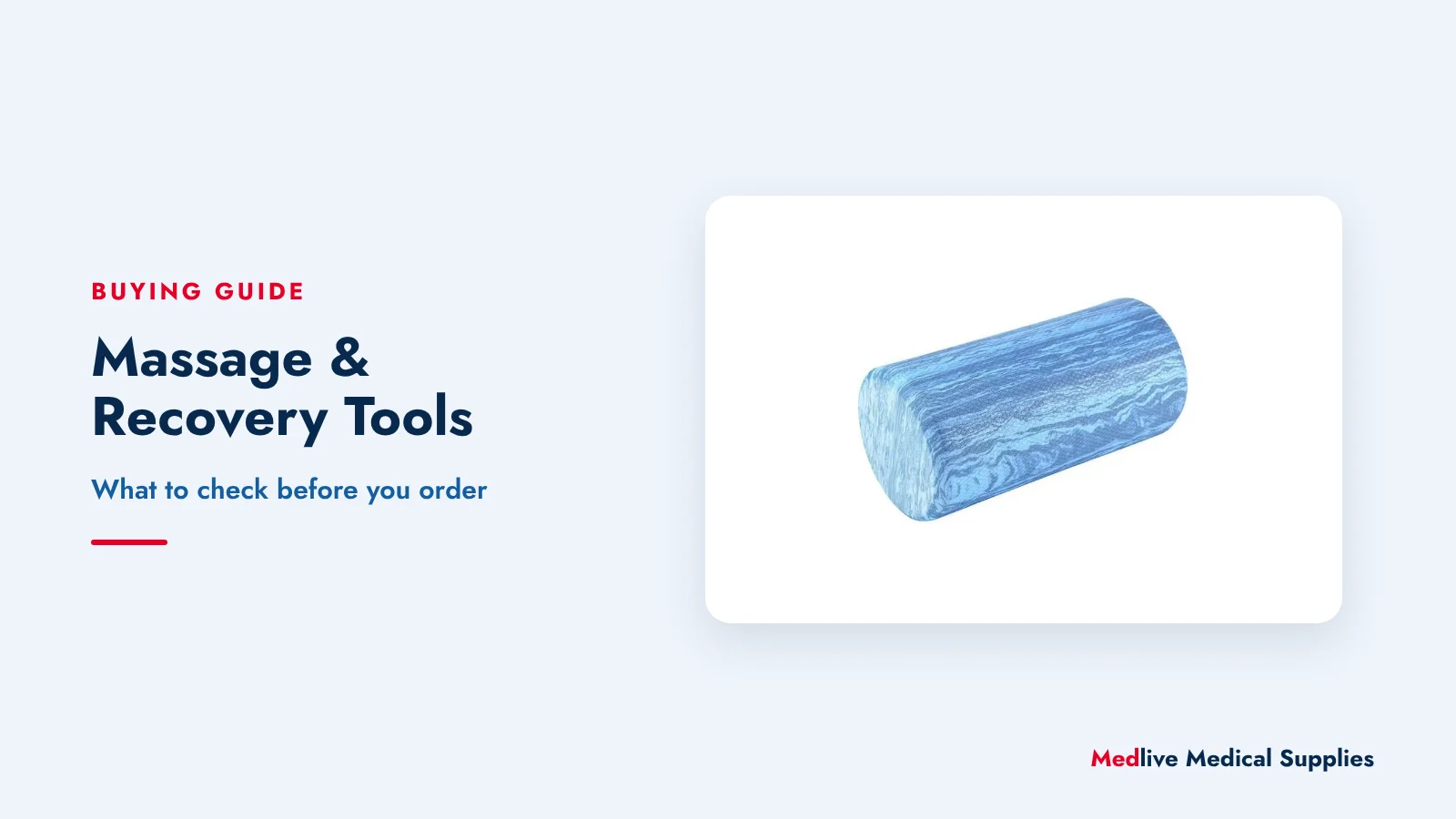
Foam rollers differ in length, diameter, firmness and surface. Longer rollers are easier to balance on when lying across them; shorter rollers pack more easily into a kit bag. Smooth rollers give an even surface, while grid or textured surfaces have raised areas. The range includes, for example, the Synergy 30cm Foam Roller and the Synergy Grid Foam Roller 33.5cm x 12.8cm Black. For clinic use, look for a firm core or dense foam that will hold its shape over months of daily use, and a surface that can be wiped clean.
Massage balls and small rollers target smaller areas such as the foot or shoulder region. Examples in the range include the Synergy Massage Ball 8cm Yellow and the TheraBand Foot Roller. Check size and firmness on the product page, and consider buying a set of different firmness options if several clients will use them.
Trigger-point and soft-tissue hand tools, for example the Thera Press Massage Tool and the Physio Blade Soft Tool, are designed for applying pressure or for instrument-assisted soft-tissue techniques. Instrument-assisted techniques should be performed only by practitioners trained in them. Practices should check the material, edge profile and whether the tool can be cleaned and disinfected between clients.
3. Percussion massage guns
Massage guns vary in weight, attachments, speed settings, battery and noise. Before buying, consider:
- Attachments: how many heads are included and whether they are easy to clean.
- Battery: stated run time, charging method and whether spare batteries or chargers are available.
- Weight and grip: a practitioner using a gun for several sessions a day will notice a heavy unit.
- Noise: relevant in shared treatment areas and gyms.
The Compex Fixx 2.0 Massage Gun is one example in the range. Use the manufacturer’s specifications on the product page rather than general marketing claims when comparing models; our product comparison page can help line up options side by side.
4. Pneumatic compression recovery systems
Compression recovery boots and sleeves use an air pump that inflates chambers in a garment. The Therabody JetBoots Prime is an example in the range. Points to confirm before ordering:
- System or garment: whether you are buying a complete system or additional garments for an existing unit.
- Sizing: garments come in sizes, so a team may need several sizes to fit all players.
- Power and charging: mains or battery operation and charging time.
- Use and contraindications: read the manufacturer’s instructions for use, which set out who should not use the device; a clinician should advise where there is any doubt.
5. Massage creams, oils and gels
Massage media are consumables, so the buying decision is mostly about format and quantity. The range includes, for example, Taurumi Massage Cream 450g Tub, Arnica Oil 1L and Bio-Soothe Cooling Gel 500ml.
- Tubs versus bottles and refills: practices often prefer larger containers and decant into smaller pump bottles for hygiene; home users usually prefer a smaller size.
- Ingredients and allergies: read the ingredient list on the label before use, ask clients about known skin sensitivities and carry out a patch test as the labelling directs.
- Labelling: follow the manufacturer’s directions, storage conditions and expiry dates. We describe these products by their contents and format only; we do not make therapeutic claims for them.
Cooling and warming products overlap with our hot and cold therapy range; see the hot and cold therapy buying guide for ice packs, heat packs and related items.
6. Hygiene for shared tools
When a roller, ball or hand tool is used by more than one person, cleaning becomes part of the purchase decision:
- Choose non-porous surfaces where possible, because open-cell foam and fabric covers are harder to clean.
- Check the manufacturer’s guidance on which cleaning and disinfecting products are compatible with the material.
- Keep a cleaning routine between clients and replace items that crack, split or lose their shape.
- For teams, consider buying one tool per player for items used against the skin.
7. Common mistakes to avoid
- Buying a single tool for a whole team, which creates queues and hygiene problems.
- Choosing massage media without checking ingredients against known allergies.
- Ordering compression garments without confirming sizes or compatibility with an existing pump.
How to order from Medlive
Browse the massage and recovery products, or the wider Mobility & Rehabilitation department. For the full department, see our mobility and rehabilitation equipment buying guide. Customers in South Africa see verified ZAR prices including VAT on eligible products and can add them to the cart. Customers in other African countries see Price on request (USD) and can request a quotation; freight and any import paperwork are confirmed on the quotation. Practices and teams ordering several units can use bulk orders. Payment is by EFT once the final total, including freight, has been confirmed in writing.