This category serves two very different buyers. Home users and their families buy CPAP, APAP and bilevel machines for sleep therapy that a clinician has prescribed. Hospitals, ambulance services and clinical engineering teams buy ventilators and breathing circuits for patients who need ventilatory support. Both need the right device, the right accessories and a plan for servicing. This guide covers what to compare when buying. The therapy itself, including device type, pressure settings and mask choice, is decided by the treating clinician, and every device must be used according to the manufacturer’s instructions.
1. Home sleep therapy: CPAP, APAP or bilevel
Sleep therapy devices are normally bought after a sleep study and a prescription that specifies the device type and settings. Our ventilators and CPAP range includes examples of each type:
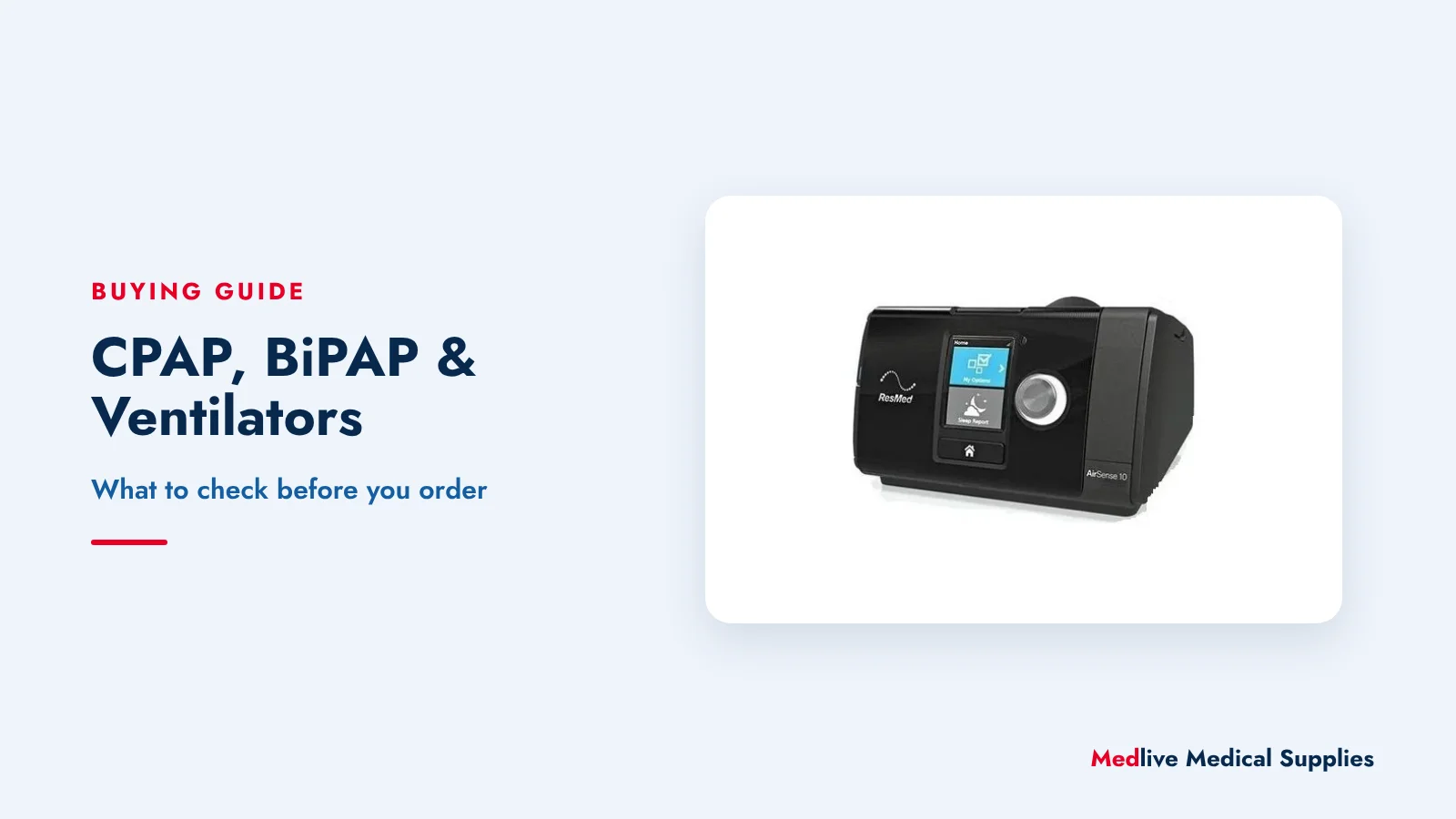
- CPAP devices deliver a continuous pressure set by the clinician, for example the CPAP Sleep Apnea Machine Aeonmed AS100A or the ResMed AirSense 10 CPAP with Humidifier.
- Auto-adjusting (APAP) devices vary pressure within a range set by the clinician, for example the Lowenstein Prisma SMART APAP Device or the BMC G3 A20 Auto CPAP – Travel.
- Bilevel devices provide different pressures for breathing in and out. The BiPAP ST30 Non-Invasive Ventilator is an example. These are generally prescribed for specific clinical needs.
Bring the prescription when you request a quotation, so the device offered matches what the clinician has specified.
2. Features to compare for home devices
- Humidification: some devices include an integrated heated humidifier, others offer it as an option. Ask whether it is included.
- Data and reporting: many devices record usage and therapy data that the prescriber can review. Check how data is accessed (memory card, app or remote connection) and what your clinician prefers.
- Travel units: compact devices suit frequent travellers. Compare size, weight and whether a humidifier is available.
- Power: during power interruptions or load-shedding, users often ask about inverters, batteries or DC power. Requirements differ between models, so ask us to confirm what each manufacturer supports before buying any power accessory.
- Consumables: filters, tubing, water chambers and mask cushions wear out. Follow the manufacturer’s replacement intervals and budget for them.
3. Choosing and replacing masks
The mask matters as much as the machine for many users. The main styles are nasal masks, nasal pillows and full face masks. Examples in our range include the ResMed AirFit N20 Nasal CPAP Mask and the Fisher & Paykel Eson 2 Nasal Mask.
- Masks come in different sizes, and fit depends on the individual. Use the manufacturer’s sizing guide and ask the prescriber or sleep technologist for advice.
- Confirm the mask connects to standard CPAP tubing for your device.
- Cushions, headgear and filters have replacement intervals set by the manufacturer. Ordering spares together saves repeat freight.
4. Facility ventilators: ICU, transport and non-invasive
Ventilators for hospitals and emergency services are specified by clinicians and clinical engineering teams, usually through a formal procurement process. Broad categories include ICU ventilators, such as the Ventilator Medical PA-700B ICU, transport ventilators, such as the Ventilator Transport – Emergency Portable, and non-invasive ventilators. When comparing models, ask for the manufacturer’s documentation on:
- Ventilation modes and the patient range the device is intended for (adult, paediatric, neonatal).
- Oxygen supply: whether it needs high-pressure piped or cylinder oxygen, or can work with low-flow oxygen.
- Battery type and run time, which is important for transport and for facilities with unreliable power.
- Alarm functions and the display layout your staff will work with.
- Servicing intervals, availability of parts, user training and technical support arrangements.
5. Breathing circuits, filters and HMEs
Breathing circuits must match the ventilator. Circuits come as double-limb, for example the Ventilator Breathing Circuit Double 1.8m Adult, or single-limb, for example the Ventilator Breathing Circuit Single 1.2m Adult. Check which configuration the ventilator manufacturer specifies, the length needed for your bed spaces, and whether the circuit is adult or paediatric. Plan for filters and heat and moisture exchangers (HMEs) as specified for each device, and follow single-use or reprocessing instructions exactly.
Ventilation equipment is often bought with oxygen and airway devices. See our oxygen concentrators and oxygen therapy buying guide and nebulisers and suction units buying guide, and for the full category, our respiratory equipment buying guide.
6. How to order from Medlive
Browse the ventilators and CPAP sub-category or the full respiratory equipment department. South African customers see verified prices in ZAR including VAT where available and can add items to the cart. Customers in other African countries see Price on request (USD); freight and import paperwork are confirmed on the quotation.
- For a CPAP device with masks and spares, or for questions about compatibility, use Request a Quotation and attach the prescription details where relevant.
- For circuits, filters and consumables in volume, use Bulk Orders.
- Hospitals, emergency services, government departments and NGOs procuring ventilators can submit specifications through Tender Enquiry.
Freight is confirmed per order, and payment is made by EFT once the final total has been confirmed in writing.