Disinfectants, sharps containers and waste supplies rarely get much attention until they run out, yet they underpin infection prevention in every clinic, ward, laboratory and practice. Buying the wrong product can mean surfaces that are not properly treated, equipment damaged by an incompatible chemical, or sharps bins overfilled because the right size was not available. This guide explains what to compare and how to estimate quantities. Your facility’s infection prevention and control policy should always decide which products are used where.
1. Surface disinfectants: ready-to-use or concentrate
Our disinfectants and waste range includes both ready-to-use products and concentrates, for example B Braun Alcohol Surface Disinfectant 500ml, B Braun D-Germ Surface Disinfectant 5L, B Braun Cetidine Disinfectant Concentrate 5L and Surfasbac – Surface Disinfectant And Cleaner 5L.
- Ready-to-use products need no mixing, which reduces dilution errors. They suit clinics and smaller sites and are convenient at the point of care.
- Concentrates are diluted on site and can be economical for high-volume cleaning. They need correct dilution exactly as stated on the label, suitable measuring equipment, labelled secondary containers and staff trained in preparation.
- Contact time: every disinfectant has a contact time stated by the manufacturer, the time the surface must stay wet for the product to work as labelled. Choose products whose contact time is practical for the way your staff work.
- Wipes, such as Alcohol Wipes Large Individually Wrapped 190x120mm, are convenient for small surfaces and items. Keep packs closed so they do not dry out.
2. Compatibility and safety information
Not every disinfectant suits every surface. Alcohol and some other chemicals can damage plastics, screens, upholstery or rubber over time. Before choosing a product for medical equipment, check the device manufacturer’s cleaning and disinfection instructions, which often list approved agents.
Read the product label and request the safety data sheet (SDS) for every chemical you store. The SDS sets out hazards, required protective equipment, storage and first-aid information. Store concentrates away from heat and out of reach of the public.
Registration and approval requirements for disinfectants vary by country. In South Africa, chemical disinfectants are subject to a compulsory specification administered by the National Regulator for Compulsory Specifications (NRCS). If you buy for another country, check the local requirements and ask for the product documentation you need with your quotation.
3. Hand hygiene versus surface products
Hand rubs and surface disinfectants are formulated for different purposes and should not be used interchangeably. A hand product such as the B Braun Alcohol Hand Gel Disinfectant 500ml is intended for hands; surface products are intended for surfaces and equipment. Follow the label for each. For soap, dispensers, paper towels and other hand hygiene supplies, see our washroom and hand hygiene range.
4. Sharps containers
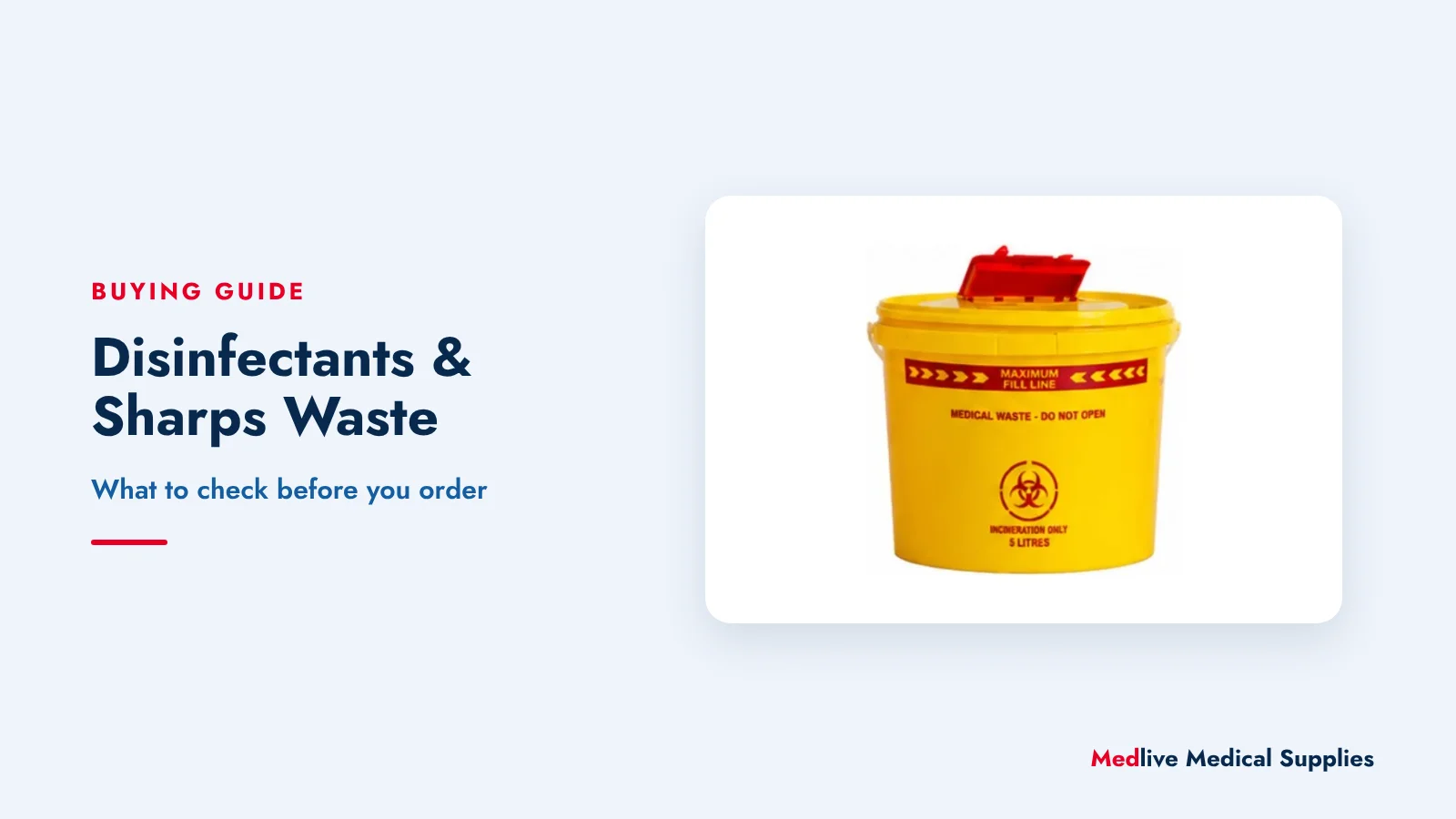
Sharps containers should be placed as close as practical to where sharps are used, so the size depends on the setting:
| Size | Typical placement |
|---|---|
| Medical Sharps Waste Bin 2.5L | Dressing and procedure trolleys, small treatment areas |
| Medical Sharps Waste Bin 5L | Consulting rooms, treatment rooms, ward bays |
| Medical Sharps Waste Bin 20L | High-volume areas such as vaccination points, laboratories and pharmacies |
- Fill line: never fill past the marked fill line. Replace containers before they reach it.
- Closure: check that the temporary and final closures work smoothly, so containers can be closed between uses and sealed securely for collection.
- Construction: containers should be rigid and puncture resistant. Ask for the manufacturer’s specification if your waste contractor or policy requires a particular standard.
- Mounting: wall brackets or trolley holders keep containers stable and upright. Confirm bracket compatibility with each size.
5. Healthcare risk waste and spills
Sharps and other healthcare risk waste must be segregated, packaged, stored and collected in line with local regulations, and removed by a licensed waste contractor. In South Africa, SANS 10248 covers the management of healthcare risk waste. Other countries have their own rules; check with your local authority and contractor.
Keep spill supplies where body-fluid spills are likely. Absorbent Granules 100g, for example, help contain liquid spills before clean-up. Follow your facility’s spill procedure, wear the protective equipment it specifies and dispose of the waste as healthcare risk waste. Reusable instruments are a separate stream: they are cleaned and sterilised rather than disinfected with surface products; see our autoclaves buying guide.
6. Estimating monthly quantities
- Count the points of use: trolleys, rooms, bays and departments, and how many sharps containers each needs at a time.
- Track how often containers are replaced and how many litres of disinfectant each area uses per week, then multiply out to a month with a margin for busy periods.
- Note shelf life and expiry dates on disinfectants and hand rubs, and avoid ordering more than you can use in time.
- Agree a regular order cycle so supplies arrive before stock runs low.
For gloves, masks, gowns and the rest of the infection control range, see our PPE and infection control buying guide.
7. How to order from Medlive
Browse the disinfectants and waste sub-category or the full PPE and infection control department. South African customers see verified prices in ZAR including VAT where available and can add items to the cart. Customers in other African countries see Price on request (USD); freight and import paperwork, including any restrictions on shipping chemicals, are confirmed on the quotation.
- For a mixed list of disinfectants and containers, use Request a Quotation.
- For regular monthly supply in volume, use Bulk Orders.
- Hospitals, government departments and NGOs with a formal procurement process can submit requirements through Tender Enquiry.
Freight is confirmed per order, and payment is made by EFT once the final total has been confirmed in writing.