IV cannulas, giving sets, urinary catheters, drainage bags and tubes are used every day in almost every ward and clinic, so small purchasing decisions add up quickly. Running short of one gauge, or receiving giving sets that do not connect to your pumps, disrupts care. This guide explains the sizing systems, the main product differences and how to plan quantities. It is purchasing guidance only: which device and size is used for a patient is a clinical decision made under your facility’s protocols and the manufacturer’s instructions for use.
1. IV cannulas: gauge, colour and stock spread
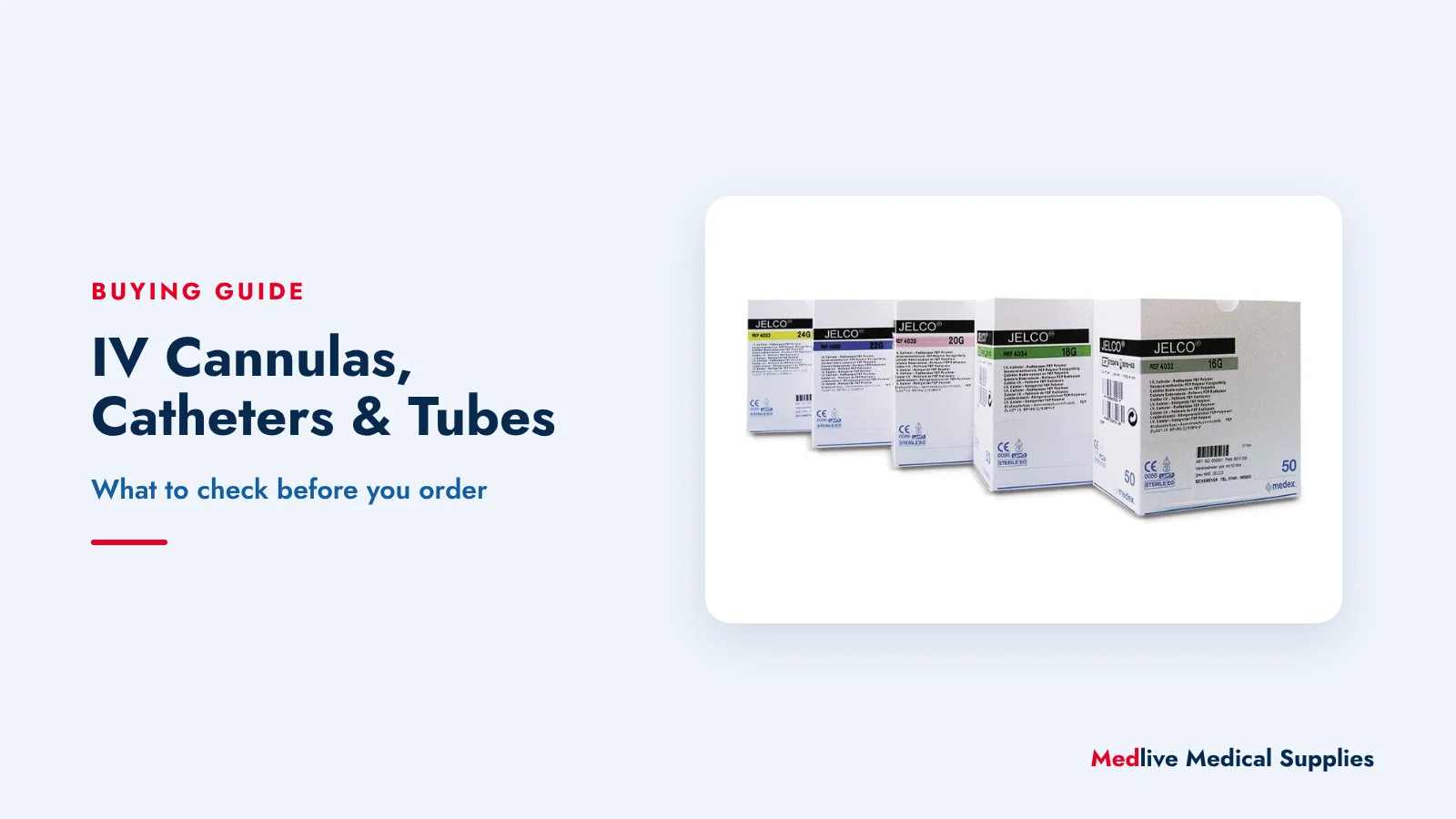
Peripheral IV cannula size is given in gauge (G). The lower the number, the larger the bore: a 14G cannula is wider than an 18G, which is wider than a 22G. Our IV, catheters and tubes range includes sizes across this spread, for example IV Cannula 14G Box 50, IV Cannula 18G Box 50, Jelco IV Cannula 18G Box 50, IV Cannula 22G Box 50 and IV Cannula 24G Paediatric Box 50.
- Colour coding: cannula hubs are colour-coded by size, and ISO 10555-5, the international standard for over-needle peripheral catheters, includes an annex on hub colours. Most manufacturers follow a common scheme, but always read the gauge printed on the pack and device rather than relying on colour alone.
- Stock spread: base your order on actual usage by gauge from the last few months, not on an even split. Most facilities use some sizes far more than others.
- Paediatric and neonatal areas use the smaller gauges; order these separately for the units that need them.
- Safety cannulas: if your facility requires cannulas with a needlestick protection feature, state this on your quotation request.
2. Giving sets, stopcocks and extensions
A giving set connects the fluid bag to the cannula. Points to confirm:
- Standard or burette: burette sets, such as the IV Giving Set with Burette 150ml – Paediatric, include a graduated chamber for measured volumes and are commonly used in paediatric areas.
- Drop factor: the number of drops per millilitre is stated on the pack. Staff need it for gravity flow calculations, so keep to consistent drop factors where possible and make sure the value is visible on every set.
- Pump compatibility: many infusion pumps require dedicated or approved sets. Check the pump manufacturer’s requirements before switching giving sets; see our infusion and syringe pumps buying guide.
- Connectors: confirm Luer lock or Luer slip connections are compatible across cannulas, extensions, stopcocks and syringes. Accessories such as the 3-Way Stopcock – Each must match the rest of the line. For syringes and needles, see our syringes and needles buying guide.
3. Urinary catheters and drainage bags
Foley catheter size is given in French gauge, shown as Ch or FG. Each unit equals one third of a millimetre of outside diameter, so a larger number means a wider catheter. Order the sizes your wards actually use.
- Latex or silicone: latex catheters are widely used, while all-silicone catheters such as the 100% Silicone Foley Catheter – Each are an option where latex allergy is a concern. The manufacturer states the intended maximum dwell time for each product; follow it and your facility’s protocol.
- Bed drainage bags, for example the Urinary Bag 2000ml with Reflux Valve, hang at the bedside. Check capacity, the presence of a non-return (reflux) valve and the type of outlet tap.
- Leg bags, such as the Urine Leg Bag 750ml with Tap, suit mobile patients. Check capacity, straps and tap design for ease of emptying.
4. Feeding tubes and tracheal tubes
Feeding tubes are also sized in French gauge and come in different lengths; the Feeding Tube 50cm – Sizes 5-18 FG shows how a range is described. Endotracheal tubes are sized by internal diameter in millimetres, as in the Tracheal Tube Cuffed ETT 7.5mm – Box 10, and may be cuffed or uncuffed. These items are selected by clinicians and anaesthesia teams; purchasing should simply make sure the agreed range of sizes is available in the right quantities.
5. Sterility, expiry and standardisation
- Sterile, single-use: these products are supplied sterile for single use. They must never be reused or resterilised. Do not use items from damaged or opened packaging.
- Expiry rotation: check expiry dates on receipt, store first-expiry-first-out, and avoid ordering more of slow-moving sizes than you can use before they expire.
- Box quantities: many items are sold in boxes, for example 50 cannulas per box. Plan orders in whole boxes and note whether the price is per item or per box.
- Standardise: keeping to the same brands and connector types across a facility helps staff familiarity, reduces mistakes and simplifies training. Discuss any change with the clinical team first.
For the wider range of ward consumables, see our medical consumables buying guide.
6. How to order from Medlive
Browse the IV, catheters and tubes sub-category or the full medical supplies and consumables department. South African customers see verified prices in ZAR including VAT where available and can add items to the cart. Customers in other African countries see Price on request (USD); freight and import paperwork are confirmed on the quotation.
- For a mixed list of gauges, sizes and box quantities, use Request a Quotation.
- For regular ward or facility supply in volume, use Bulk Orders.
- Hospitals, government departments and NGOs with a formal procurement process can submit requirements through Tender Enquiry.
Freight is confirmed per order, and payment is made by EFT once the final total has been confirmed in writing.