A mattress is easy to overlook when equipping a ward, a care home or a home-care bedroom, yet it is in contact with the patient for most of the day. The right choice depends on the bed frame, the setting, cleaning requirements and the patient’s assessed pressure-care needs. This guide explains the main types in our mattresses and pressure care range, what to check before buying and how to order from Medlive.
1. Pressure care is a clinical decision
Pressure ulcer risk is assessed by nurses and other clinicians using their facility’s protocol and risk-assessment tools. That assessment, not the purchasing team, should decide which support surface a patient needs. Medlive does not advise on clinical choice. Our role is to help you find products that match the specification your clinicians or tissue-viability team have set, and to supply the manufacturer’s information so you can check it.
Before you order, agree with the clinical team:
- Which patients or beds the mattresses are for, and the level of support specified.
- Whether you need a full replacement mattress, an overlay that sits on an existing mattress, or a cushion for seating.
- The bed frames in use and their mattress dimensions.
- Who will clean, inspect and maintain the mattresses.
2. Standard foam hospital mattresses
Standard foam mattresses, for example the Standard Hospital Bed Mattress DF7 and the Standard Hospital Bed Mattress DF8, are the everyday mattress for hospital and home-care beds. Check:
- Size: the length, width and depth must match the bed frame. A mattress that is too small leaves gaps at the sides or ends; one that is too deep can reduce the effective height of the side rails. Measure the bed platform before ordering.
- Profiling beds: if the bed has a sectioned, profiling platform, ask whether the mattress is suitable for it.
- Cover: look for a waterproof, cleanable cover. Many covers are also described as vapour-permeable. Check the zip position and whether there is a flap protecting it, because fluid entering through a zip can contaminate the foam.
- Cleaning: ask which cleaning and disinfecting agents the manufacturer permits on the cover.
Our hospital bed buying guide and the hospital beds range will help you match mattresses to frames.
3. Alternating pressure overlays and mattress systems
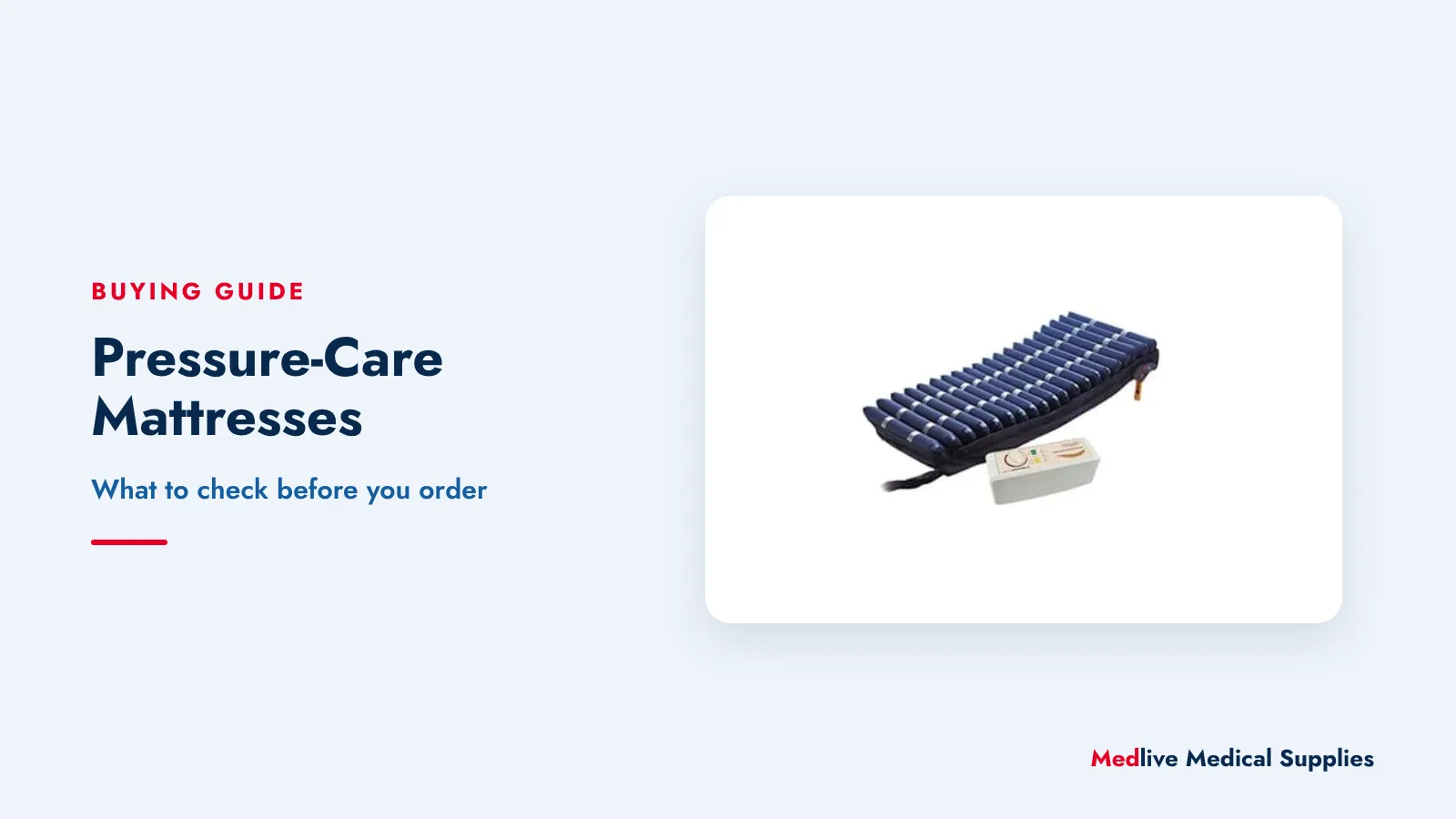
Alternating pressure products use air cells that inflate and deflate in a cycle, controlled by an electric pump. There are two broad formats:
- Overlays, for example the QDC 501 Alternating Pressure Mattress Overlay, are placed on top of an existing mattress. Check the combined height against the side rails.
- Replacement mattress systems, for example the Alternating Pressure Mattress QDC 8090, take the place of the standard mattress.
When comparing systems, ask for the manufacturer’s specification sheet and check the cell design and size, the pump controls and alarms, the maximum user weight, the power supply and what happens during a power failure, how the system is managed for patient transport and in an emergency, and the availability of replacement cells, pumps and covers. Pumps need mains power, so consider where they will be used and how reliable the supply is.
4. Cushions
Seating cushions are used on chairs and wheelchairs. Our range includes, for example, the Anti-Decubitus Ring Doughnut Cushion. Be aware that some clinical guidance, including NHS patient information on pressure ulcer prevention, advises against ring or doughnut-shaped cushions for pressure relief, because the edges of the ring can concentrate pressure. Ask your clinician or tissue-viability team whether a cushion of this type is appropriate before buying one for a specific patient.
5. Infection control, inspection and replacement
Mattresses are shared equipment in most facilities and need a routine:
- Clean covers between patients using products the manufacturer permits, following your facility’s infection-control procedures.
- Inspect regularly: unzip the cover and check the inside of the cover and the foam core for staining or damp. Look for tears, punctures and worn seams on the outside.
- Replace damaged covers or mattresses promptly. Ask whether replacement covers are available separately.
- Keep records of each mattress or system, its location, inspections and any servicing of pumps.
6. Home care and common mistakes
For home care, confirm the bed dimensions, the patient’s assessed needs and that there is a suitable power point for any pump. The family or carer should receive the manufacturer’s instructions for use and know who to contact if a pump alarm sounds.
Common mistakes to avoid:
- Ordering a mattress without measuring the bed frame.
- Choosing a support surface without the clinical team’s assessment.
- Ignoring the combined height of an overlay and mattress against the side rails.
- Not budgeting for replacement covers, cells and pump servicing.
To compare models, use our product comparison tool. For the wider range, see our hospital and critical care buying guide.
7. How to order from Medlive
Browse the mattresses and pressure care range or the full Hospital & Critical Care department. In South Africa, products with verified prices show ZAR prices including VAT and can be added to the cart. Customers in our other markets see “Price on request (USD)” and can Request a Quotation; freight and import paperwork for other African countries are confirmed on the quotation.
Replacing mattresses across a ward or facility? Use Bulk Orders for volume quotations, or Tender Enquiry for institutional and government requirements. Freight is confirmed for each order, and payment is by EFT once the final total has been confirmed in writing.