Stretchers and trolleys move patients, instruments, dressings and medicines around a facility every day, so the wrong choice shows up quickly: a stretcher that will not lock into an ambulance, a dressing trolley that is hard to clean or a medicine trolley that cannot be secured. This guide covers both halves of the range, patient stretchers and ward trolleys, and explains what to check before you order.
1. Start with the job and the route
Before comparing models, write down where the item will be used and how it will travel:
- Setting: emergency department, ward, theatre, clinic, ambulance, mine or event medical post.
- Route: door widths, lifts, ramps, corridors and the floor surface between rooms. Measure the narrowest point.
- Users: how many staff will push, lift or load the stretcher, and what manual handling training they have.
- Patients: the heaviest patients you expect to move, and whether you also need paediatric options.
2. Types of stretcher
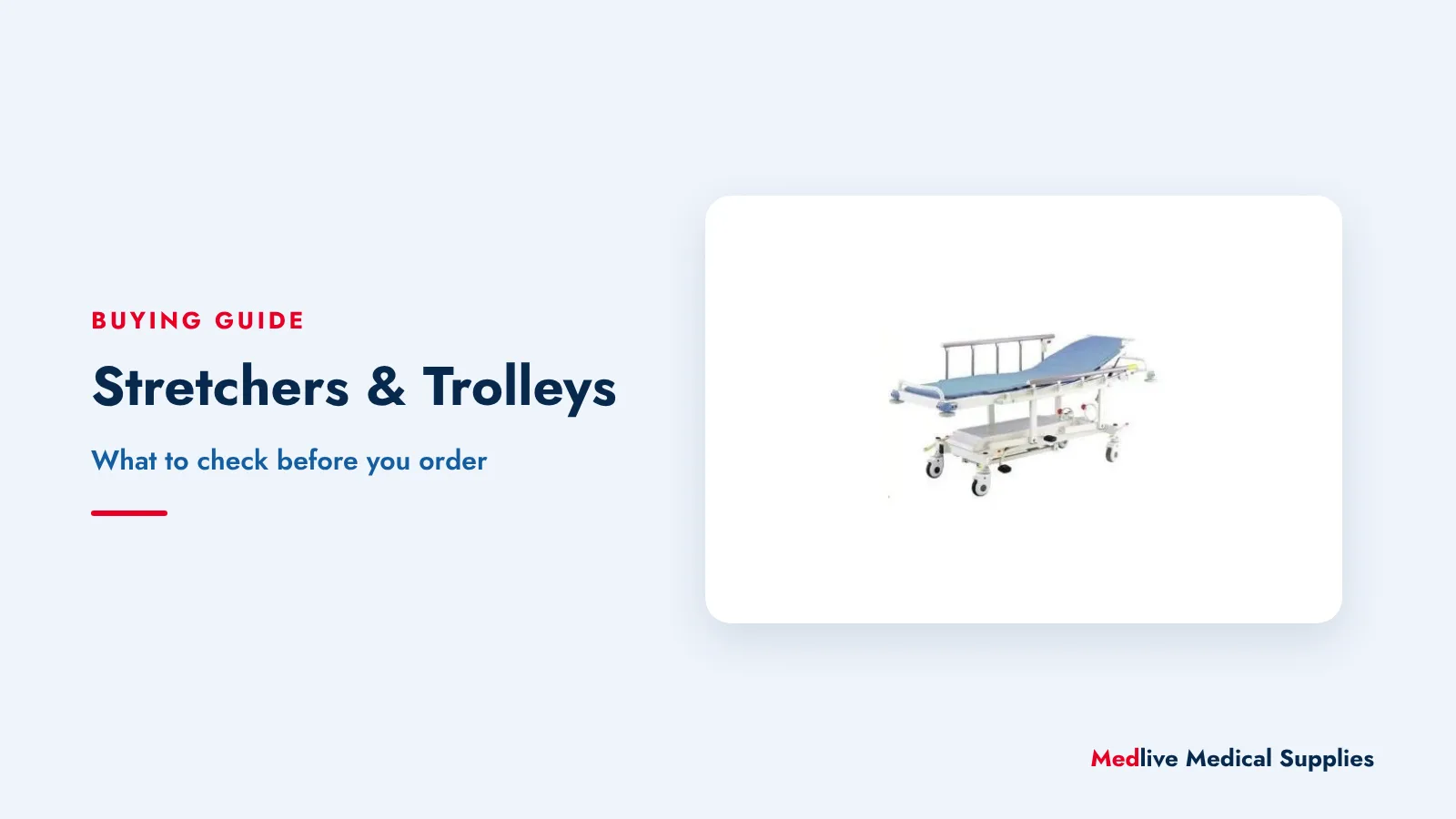
The Stretchers & Trolleys range includes several designs that are not interchangeable:
- Hospital transport (trolley) stretchers: wheeled stretchers for moving patients within a facility, often with hydraulic height adjustment and a backrest. Examples in the range include the Hydraulic Patient Transport Stretcher E-2 and the Emergency Trauma Stretcher E-8.
- Ambulance stretchers: designed to be loaded into a vehicle, for example the Self-Loading Ambulance Stretcher. The stretcher must be compatible with the vehicle’s mounting and locking system, so ask the vehicle builder or fleet manager for the mounting details and confirm compatibility with us before ordering.
- Scoop stretchers: split lengthways so they can be placed under a patient from both sides, for example the Scoop Stretcher Adjustable Aluminium. Use follows your service’s protocols and training.
- Folding stretchers: light and compact for storage in vehicles, sports venues or disaster stock, for example the Four-Fold Patient Transfer Stretcher DW-F006.
Spine boards, head immobilisers and other immobilisation equipment sit in our Rescue & Safety Equipment range within the Emergency & First Aid department.
3. Stretcher specifications that matter
- Safe working load: check the manufacturer’s stated maximum load and compare it with the patients you serve, allowing for equipment carried on the stretcher.
- Height adjustment: hydraulic, gas-spring or fixed. Adjustable height helps with transfers to beds and examination couches and reduces bending for staff.
- Backrest and positioning: whether the backrest and leg section adjust, and how the mechanism is operated.
- Side rails: fold-down or removable rails, how they lock and whether they obstruct transfers.
- Accessories: IV pole, oxygen cylinder holder, mattress and restraint straps. Confirm which are included and which are extras.
- Castors and brakes: castor size, central or individual braking, and whether one castor can be locked for straight-line steering.
- Cleaning: smooth surfaces, a wipeable mattress cover and few hard-to-reach joints make cleaning between patients quicker. Follow your facility’s infection-prevention procedures and the manufacturer’s cleaning instructions.
4. Ward and theatre trolleys
Trolleys look simple, but each type has its own requirements:
- Dressing trolleys: usually two shelves with rails to stop items sliding off, for example the Dressing Trolley Stainless 80x50cm with Rails. Check the shelf size against the trays and packs you use.
- Instrument trolleys: a Mayo-style stand, such as the Instrument Trolley – Mayo Stand, holds an instrument tray over the patient or operating table. Check the height range and how the tray is fixed.
- Medicine trolleys: lockable drawers or compartments, for example the Medicine Trolley Double-Sided Lockable. Ask about the lock type, key control and drawer layout, and check the trolley against your facility’s medicine security policy.
- Linen and food trolleys: consider capacity, covers or lids, and how easily bags or containers are changed.
5. Materials, castors and durability
Stainless steel is common for clinical trolleys because it can be cleaned repeatedly with suitable disinfectants. Ask which grade and finish are used and which cleaning agents the manufacturer approves. Powder-coated and plastic trolleys can be lighter and quieter but may mark or chip over time.
Castors take the most wear. Check the castor diameter for your floors, whether two or four castors have brakes, and whether replacement castors and spare parts are available. Larger castors generally roll more easily over thresholds and uneven surfaces.
6. Common mistakes to avoid
- Ordering an ambulance stretcher without confirming the vehicle mounting.
- Choosing a stretcher whose safe working load does not suit the patients you transport.
- Forgetting accessories such as the IV pole, mattress or straps.
- Buying trolleys too wide for lifts, doorways or bed bays.
- Overlooking spare castors, brakes and servicing of hydraulic parts.
Use our product comparison tool to compare stretcher and trolley specifications side by side. For beds, monitors and the wider hospital range, see our Hospital & Critical Care buying guide.
7. How to order from Medlive
Browse the stretchers and trolleys range or the full Hospital & Critical Care department. In South Africa, products with verified prices show ZAR prices including VAT and can be added to the cart. Customers in our other markets see “Price on request (USD)” and can submit a Request a Quotation.
Equipping a ward, a new facility or an ambulance fleet? Use Bulk Orders for volume quotations, or Tender Enquiry for institutional and government requirements. Large items are bulky, so freight is confirmed for each order, and payment is by EFT once the final total has been confirmed in writing. Buyers outside South Africa can read ordering medical supplies outside South Africa; freight and import paperwork are confirmed on the quotation.