Equipping an intensive care or high-care unit is one of the largest purchasing projects a hospital undertakes. The most reliable way to plan it is bed space by bed space: decide what every bed needs, what the unit shares, and what has to be in place before any equipment arrives. This guide sets out that checklist for procurement teams, unit managers and clinical engineers. The clinical specification itself must come from the unit’s clinicians and clinical engineering team; this guide is about organising the purchase.
You can see the products discussed here on our ICU and high-care equipment page.
1. Start with the unit, not the catalogue
Before comparing models, agree the basics in writing:
- Number of beds, and whether each is intensive care or high care. The two levels usually need different amounts of equipment per bed.
- Patient mix: adult, paediatric, surgical, medical or mixed.
- Which items sit at every bed and which are shared across the unit.
- Who signs off the clinical specification, and who signs off the budget.
2. The bed-space checklist
Use this table as a starting point and adjust it to your unit’s protocols.
| Item | Typically planned | Example in our range |
|---|---|---|
| Bed and pressure care | Per bed | Electric ICU Hospital Bed – Full-Function DA2 |
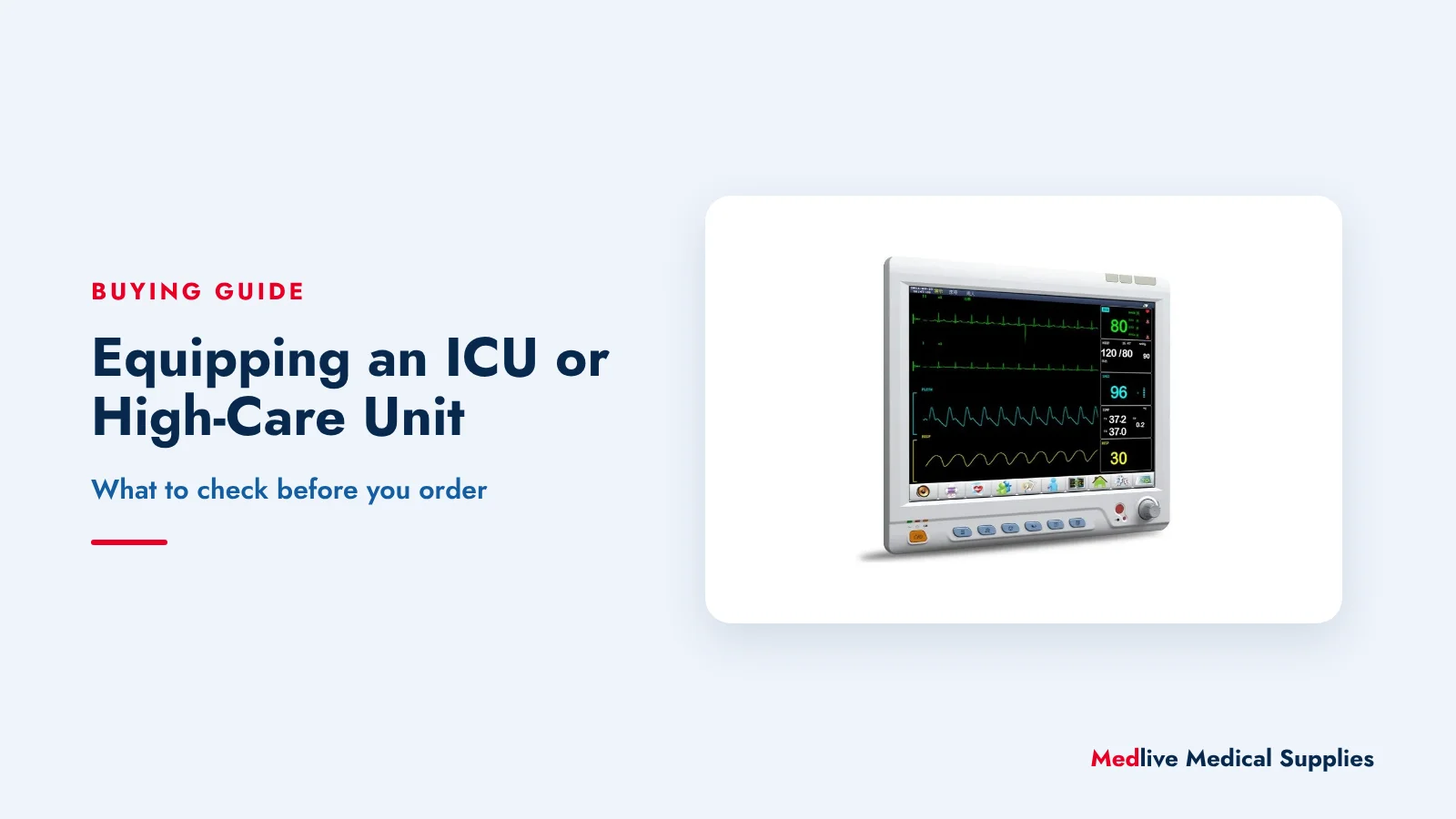
| Patient monitor | Per bed | Multi-Parameter ICU Monitor – 15 inch; Contec CMS8000 Multi-Parameter Patient Monitor |
| Infusion and syringe pumps | Per bed, quantity set by clinicians | Infusion Pump KL-8052N; Syringe Pump KL-602 |
| Enteral feeding pump | Per bed or shared | Feeding Pump KL5021A |
| Ventilation | Per ICU bed; as required in high care | Ventilator Medical PA-700B ICU |
| Capnography | Per bed or shared | Capnograph CA10S |
| Suction | Per bed | See the department range |
| Fluid warming and pressure infusion | Shared | Fluid & Blood Warmer HAWK-FW1; Pressure Infusion Cuff RU500PGS 500ml |
| Defibrillator | On the unit | Defi Xpress Biphasic Defibrillator with AED |
| Wound therapy | Shared, as needed | Negative Pressure Wound Therapy NPWT Portable |
Each of these categories has its own buying guide:
- Beds: our hospital beds buying guide covers sections, safe working load, mattresses and pressure care.
- Monitors: see choosing a patient monitor for ward, clinic or ICU for parameters, screens and alarms.
- Pumps: the infusion and syringe pumps buying guide explains volumetric and syringe pumps, drug libraries and consumables.
- Ventilation: our CPAP, BiPAP and ventilators buying guide covers invasive and non-invasive options.
- Defibrillation: the AED and defibrillator buying guide explains manual and AED modes, pads and batteries.
3. Standardise across the unit
Buying one model of each device type for the whole unit, rather than a mix, usually pays off. Staff train on one interface, alarms sound and behave consistently, spare parts and accessories are interchangeable, and consumables such as pump sets, monitor cables and sensors come from a single list. If you are adding beds to an existing unit, check compatibility with the equipment and consumables you already hold before choosing a new model.
4. Infrastructure, alarms and central monitoring
Electrical supply, backup power, medical gas outlets, suction points, pendants and data cabling are facility and engineering matters, not equipment purchases. Confirm with your engineering team that each bed space has the outlets and capacity the equipment needs before you order, and plan how equipment will behave during power interruptions.
Agree how alarms will be seen and heard across the unit. If you want a central monitoring station, ask us before ordering bedside monitors, because central monitoring depends on the monitor model, the network arrangement and the software offered by the manufacturer. We will confirm what is available for the models you are considering on the quotation.
5. Service, calibration and consumables
- Service plans: ask how each device is serviced, by whom, and at what intervals the manufacturer recommends. Clinical engineering should hold the schedule.
- Calibration and safety testing: plan for periodic performance checks and electrical safety testing by qualified technicians.
- Consumables per bed-day: estimate monitor sensors, pump sets, suction liners, ventilator circuits and filters per bed per day, then multiply by expected occupancy. This running cost often matters as much as the purchase price.
- Training: include user training for every shift when equipment is commissioned.
6. Phased purchasing and tenders
If the budget does not cover everything at once, phase the purchase so that complete bed spaces open together rather than buying part of every bed. Shared items, such as a defibrillator and suction, need to be in place from the first phase. For public-sector and institutional buyers, a written specification and bill of quantities make quotations easier to compare. Send these through our tender enquiry service and we will respond against your documents.
Common mistakes to avoid:
- Choosing equipment before the clinical team has agreed the specification.
- Mixing several models of the same device across one unit.
- Assuming the building has the power, gas and suction outlets the equipment needs.
- Budgeting for devices but not for consumables, servicing and training.
How to order from Medlive
Start with the ICU and high-care range, then browse the wider Hospital & Critical Care department. Our hospital and critical care buying guide covers the rest of the department.
Send your bed-space list through Request a Quotation, or use bulk orders for multi-bed volumes. For formal tenders, specifications and closing dates, use our tender enquiry service. Customers in South Africa see verified ZAR prices including VAT on eligible products; customers in other African countries see Price on request (USD), and freight and import paperwork are confirmed on the quotation. Payment is by EFT once the final total has been confirmed in writing.